Across the Spectrum In-Depth Review AI-Based Models for Phishing Detection
Objective
This project aims to evaluate and compare various AI-based models for phishing detection, focusing on the effectiveness of CatBoost and Neural Oblivious Decision Ensemble (NODE). It addresses phishing threats by leveraging advanced machine learning techniques for accurate detection using structured data. Key goals include benchmarking models like RF, KNN, SVM, LightGBM, CatBoost, and NODE; identifying limitations of traditional classifiers; and proposing CatBoost and NODE for their strengths in handling categorical features and complex patterns. Models will be tested on a phishing dataset using metrics like accuracy, precision, recall, and F1-score, offering insights for real-world cybersecurity applications.
Abstract
Phishing attacks remain a significant threat to cybersecurity, exploiting user trust to steal sensitive data such as credentials, financial information, and personal identifiers. As these attacks grow in sophistication and frequency, traditional rule-based detection techniques prove inadequate. This study presents a comprehensive review and evaluation of AI-based models for phishing detection, focusing on six prominent machine learning and ensemble techniques: Random Forest (RF), K-Nearest Neighbors (KNN), Support Vector Machine (SVM), CatBoost, LightGBM, and Neural Oblivious Decision Ensembles (NODE). Each model is assessed based on accuracy, precision, recall, F1-score, and computational efficiency using a benchmark phishing dataset.
While all models demonstrate competent performance, the NODE and CatBoost algorithms exhibit superior capabilities in capturing complex non-linear relationships inherent in phishing data. CatBoost, with its gradient boosting framework and native support for categorical features, achieves high classification performance with minimal preprocessing. NODE, a neural network variant optimized for tabular data, leverages feature masks and oblivious trees to outperform traditional deep learning models in structured datasets. Our comparative analysis reveals that NODE not only matches or exceeds tree-based ensemble models in accuracy but also provides enhanced generalization and interpretability, making it highly suitable for real-time phishing detection systems.
This review not only benchmarks widely-used models but also introduces the potential of NODE and CatBoost as robust alternatives to conventional approaches. The insights derived aim to guide cybersecurity practitioners and researchers in selecting and deploying effective AI-driven solutions for phishing mitigation in dynamic digital environments.
Keywords: Phishing Detection, Machine Learning, CatBoost, NODE, Random Forest, SVM, KNN, LightGBM.
NOTE: Without the concern of our team, please don't submit to the college. This Abstract varies based on student requirements.
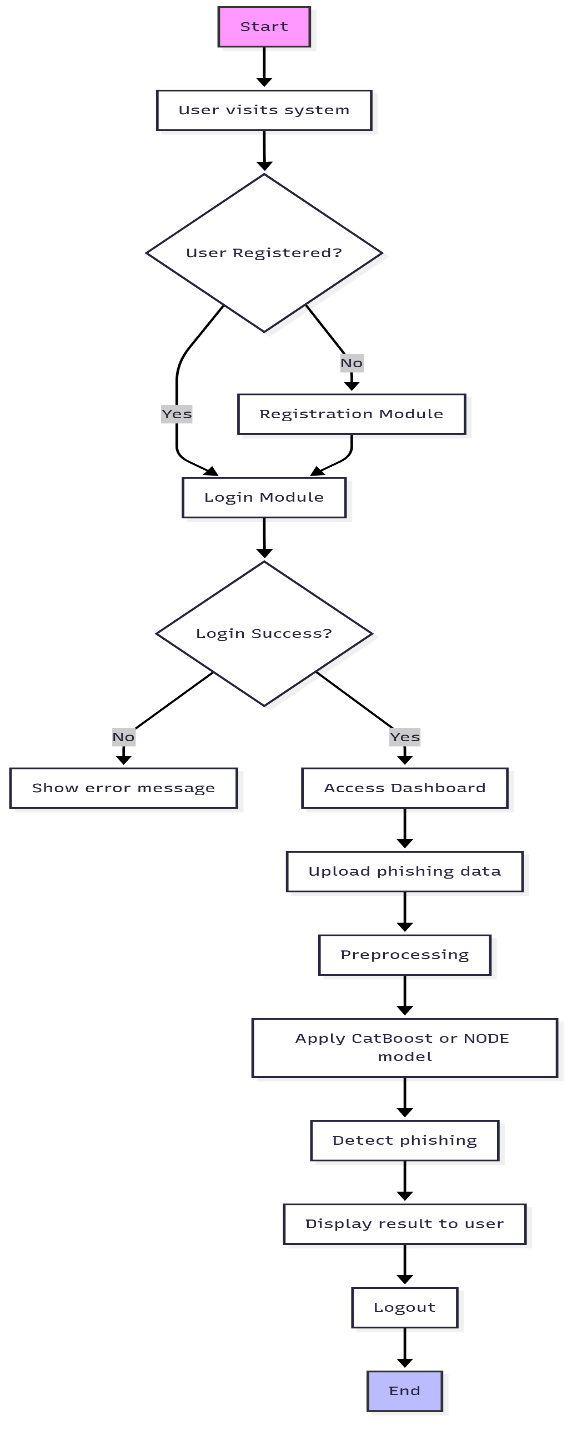
Block Diagram
Specifications
SOFTWARE REQUIREMENS
Operating System : Windows 7/8/10
Server side Script : HTML, CSS, Bootstrap & JS
Programming Language : Python
Libraries Flask, Pandas, Torch, Sklearn, Librosa, Numpy , Seaborn, Matplotlib
IDE/Workbench : VSCode
Server Deployment : Xampp Server
Database : MySQL
HARDWARE REQUIREMENTS
Processor - I3/Intel Processor
RAM - 8GB (min)
Hard Disk - 128 GB
Key Board - Standard Windows Keyboard
Mouse - Two or Three Button Mouse
Monitor - Any

Demo Video


Request for Video
 Paper Publishing
Request Call Back
Would you like to receive a free callback now?
Choose the best time for callback:
Leave your message and we will contact you as soon as possible

6-2-85/B, Old Maternity Hospital Road, Thyagaraja Nagar, Tirupati, Andhra Pradesh – 517501
+91 9030333433
+91 9393939065
0877-2261612

Disclaimer - Takeoff Edu Group Projects are not associated or affiliated with IEEE in any way. The IEEE Projects mentioned here are mentioned in the context of student projects, whose ideas are derived from IEEE publications, not projects of or by IEEE.

