Accurate Machine Learning Algorithm for Monkey Pox Based on Covid-19
Objective
The main objective of the Accurate Machine Learning Algorithm for Monkeypox based on Covid-19 is to develop a predictive model that can effectively determine whether an individual is positive or negative for the Monkeypox virus, using data from Covid-19 patients. By leveraging machine learning techniques and correlating relevant features, the algorithm aims to achieve high accuracy in early detection and diagnosis of Monkey pox, potentially aiding in timely intervention and control measures.
Abstract
The outbreak of infectious diseases has consistently posed substantial threats to public health, emphasizing the need for accurate diagnostic tools and predictive models. In this context, this research introduces an innovative approach that leverages insights from the Covid-19 pandemic to develop an accurate machine learning algorithm for the early detection and prediction of Monkeypox, a zoonotic disease caused by the Monkeypox virus (MPXV). Drawing from the experiences and data collected during the Covid-19 crisis, this study investigates the potential similarities and shared epidemiological patterns between Covid-19 and Monkeypox. It examines the possibility of utilizing data-driven techniques, such as machine learning, to enhance the accuracy and timeliness of Monkeypox diagnosis and prediction. The proposed algorithm integrates a diverse dataset, encompassing clinical, genomic, and epidemiological information, to train and validate predictive models. Advanced machine learning techniques, including deep learning and ensemble methods, are employed to capture complex patterns and interactions within the data. The primary objectives of this research are threefold: (1) to develop a highly accurate Monkeypox diagnostic tool, (2) to establish an early warning system for Monkeypox outbreaks, and (3) to facilitate a better understanding of the disease dynamics. The findings and methodologies presented in this study not only contribute to the field of infectious disease modeling but also offer valuable insights into the development of robust and adaptable machine learning algorithms that can be applied to diverse public health challenges. Ultimately, this research aims to enhance our preparedness and response capabilities in the face of emerging infectious diseases like Monkeypox, building on the lessons learned from the Covid-19 pandemic.
KEYWORDS: Linear discriminant analysis , MLP Classifer , Adaboost , ML techniques, evaluation.NOTE: Without the concern of our team, please don't submit to the college. This Abstract varies based on student requirements.
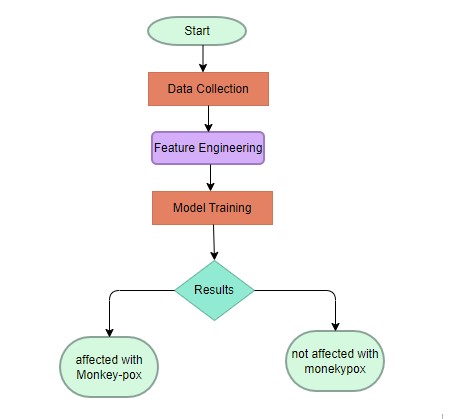
Block Diagram
Specifications
H/W CONFIGURATION:
· Processor - I5/Intel Processor
· Hard Disk - 160GB
· Key Board - Standard Windows Keyboard
· Mouse - Two or Three Button Mouse
· Monitor - SVGA
· RAM - 8GB
S/W CONFIGURATION:
• Operating System : Windows 7/8/10
• Server side Script : HTML, CSS, Bootstrap & JS
• Programming Language : Python
• Libraries : Flask, Pandas
• IDE/Workbench : PyCharm
• Technology : Python 3.6+


 Paper Publishing

Request Call Back
Would you like to receive a free callback now?
Choose the best time for callback:
Leave your message and we will contact you as soon as possible

6-2-85/B, Old Maternity Hospital Road, Thyagaraja Nagar, Tirupati, Andhra Pradesh – 517501
+91 9030333433
+91 9393939065
0877-2261612

Disclaimer - Takeoff Edu Group Projects are not associated or affiliated with IEEE in any way. The IEEE Projects mentioned here are mentioned in the context of student projects, whose ideas are derived from IEEE publications, not projects of or by IEEE.

