Accurate and Efficient Prediction of Wi-Fi Link Quality Based on Machine Learning
Objective
The objective of this project is to develop an accurate and efficient machine learning model for predicting Wi-Fi link quality. By leveraging algorithms like Random Forest, Stacking Classifier, Voting Classifier, and Decision Tree, the project aims to forecast Wi-Fi link quality based on historical data, focusing on low-complexity models suitable for resource-constrained hardware platforms. The system classifies link quality into three categories: Very Good, Good, and Poor. This approach will help optimize Wi-Fi network performance, minimize disruptions, and enable effective resource management, making it particularly beneficial for environments with limited computational capabilities or hardware resources.
Abstract
The ever-changing nature of wireless communication environments presents significant challenges in maintaining consistent communication quality, particularly in Wi-Fi networks. Predicting Wi-Fi link quality is essential for optimizing network performance, ensuring reliable connectivity, and minimizing service disruptions. This study explores the application of machine learning models for accurate Wi-Fi link quality prediction, focusing on low-complexity models that can be deployed in resource-constrained hardware environments. We evaluate several machines learning algorithms, including Random Forest, Stacking Classifier, Voting Classifier, and Decision Tree, which leverage a linear combination of exponential moving averages for performance forecasting. The models are trained on a dataset derived from real-world Wi-Fi link data, and the output is categorized into three levels of link quality: Very Good, Good, and Poor. Experimental results demonstrate the potential of these models in providing reliable, efficient, and scalable predictions, even in environments with limited computational resources.
Keywords: Wi-Fi link quality, machine learning, Random Forest, Stacking Classifier, Voting Classifier, Decision Tree, exponential moving averages, low-complexity models, link quality prediction, wireless communication.
NOTE: Without the concern of our team, please don't submit to the college. This Abstract varies based on student requirements.
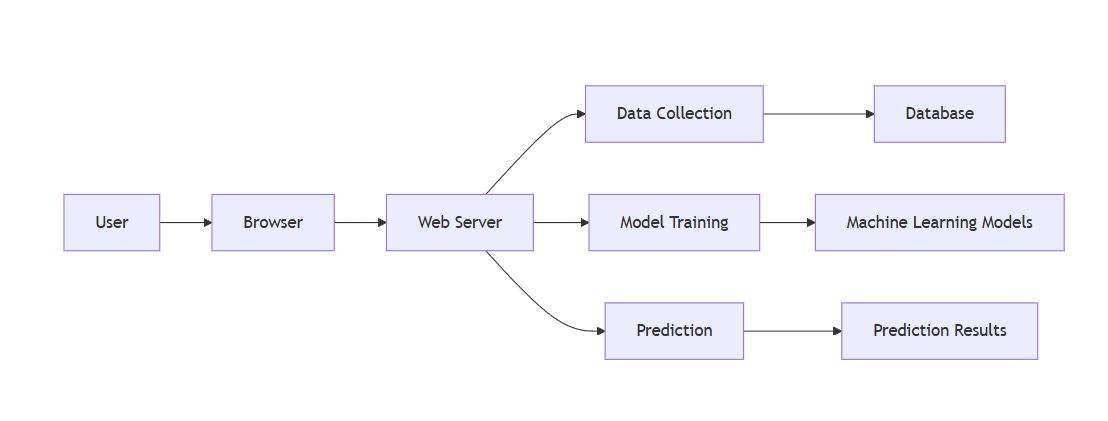
Block Diagram
Specifications
Hardware Requirements
Processor - I3/Intel Processor
Hard Disk - 160GB
Key Board - Standard Windows Keyboard
Mouse - Two or Three Button Mouse
Monitor - SVGA
RAM - 8GB
Software Requirements:
Operating System : Windows 7/8/10
Server side Script : HTML, CSS, Bootstrap & JS
Programming Language : Python
Libraries : Django, Pandas, Numpy, Tensorflow, Scikit-learn.
IDE/Workbench : VS Code
Technology : Python 3.10
Database : SQLite


 Paper Publishing

Request Call Back
Would you like to receive a free callback now?
Choose the best time for callback:
Leave your message and we will contact you as soon as possible

6-2-85/B, Old Maternity Hospital Road, Thyagaraja Nagar, Tirupati, Andhra Pradesh – 517501
+91 9030333433
+91 9393939065
0877-2261612

Disclaimer - Takeoff Edu Group Projects are not associated or affiliated with IEEE in any way. The IEEE Projects mentioned here are mentioned in the context of student projects, whose ideas are derived from IEEE publications, not projects of or by IEEE.

