ACCIDENT SEVERITY DETECTION BY USING MACHINE LEARNING
Objective
The objective of this project is to predict road accident severity (Fatal, Serious, or Slight) using machine learning models such as Random Forest, XGBoost, Logistic Regression, DNN, MLP, Stacking, Voting classifier and ensemble classifiers, to support effective emergency response and improve road safety planning
Abstract
Road accidents cause significant human and economic losses, making severity prediction an important research area. This project presents a machine learning–based approach to classify road accidents into three categories: Fatal, Serious, and Slight. The dataset includes important attributes such as road surface conditions, weather conditions, lighting conditions, vehicle types, and casualty information. These features are analyzed to identify patterns that influence accident outcomes.
Multiple models are implemented and compared to determine the most effective approach. Traditional algorithms such as Logistic Regression and Random Forest are used as baseline models. Advanced boosting techniques including XGBoost, LightGBM, and CatBoost are applied to improve prediction capability. In addition, a Feedforward Neural Network is developed to capture nonlinear relationships among features. Ensemble methods such as Stacking and Voting classifiers are also used to enhance overall performance.
The models are evaluated using accuracy, precision, recall, F1-score, and ROC–AUC metrics. Class imbalance handling techniques are applied to ensure fair classification across all severity levels. The results show that boosting and ensemble models provide improved predictive performance. The proposed framework supports data-driven analysis and contributes to improved safety planning and decision-making.
Keywords: Machine Learning, Road Accident, Severity Prediction, Random Forest, XGBoost, LightGBM, CatBoost, Neural Network, Stacking, ROC–AUC.
NOTE: Without the concern of our team, please don't submit to the college. This Abstract varies based on student requirements.
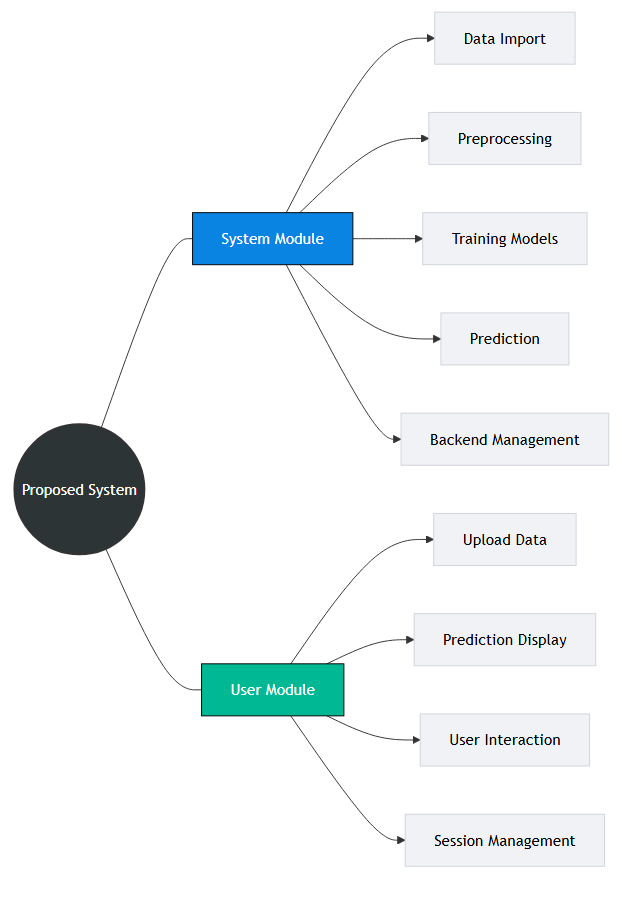
Block Diagram
Specifications
H/W CONFIGURATION:
Processor - I3/Intel Processor
Hard Disk - 160GB
Key Board - Standard Windows Keyboard
Mouse - Two or Three Button Mouse
Monitor - SVGA
RAM - 8GB
S/W CONFIGURATION:
• Operating System : Windows 7/8/10
• Server side Script : HTML, CSS, Bootstrap & JS
• Programming Language : Python
• Libraries : Flask, Pandas, MySQL. Connector, Scikit-Learn, pytorch
• IDE/Workbench : VS Code
• Technology : Python 3.8+
• Server Deployment : Xampp Server


 Paper Publishing

Request Call Back
Would you like to receive a free callback now?
Choose the best time for callback:
Leave your message and we will contact you as soon as possible

6-2-85/B, Old Maternity Hospital Road, Thyagaraja Nagar, Tirupati, Andhra Pradesh – 517501
+91 9030333433
+91 9393939065
0877-2261612

Disclaimer - Takeoff Edu Group Projects are not associated or affiliated with IEEE in any way. The IEEE Projects mentioned here are mentioned in the context of student projects, whose ideas are derived from IEEE publications, not projects of or by IEEE.

