Aadhar Based Fingerprint Electronic voting system
Abstract
Electronic voting machine (EVM) was introduced in 20th centuries, it is widely used. Traditional Electronic Voting Machines can stores only voting count of each candidate. Voter identification and allow for vote is done manually by Polling Officer using voter list. Polling officer use an indelible ink for identifying the fraudulent voter. These methods require additional man power.
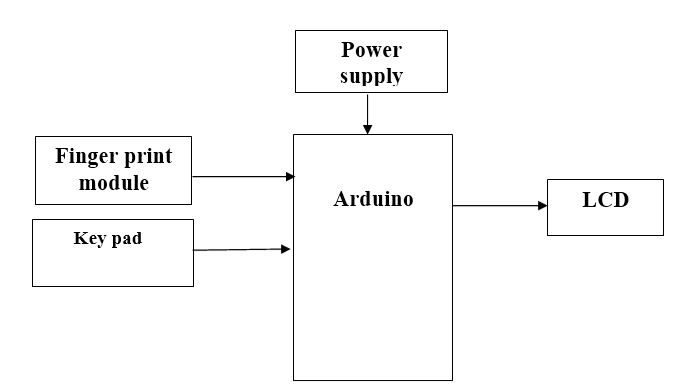
In this system, the automatic verification will be done using the voters finger print which he enrolled while he was about to register for his voters card along with it he will enroll his finger print. While he is about to vote he can place his finger print for validation if it valid he is allowed to vote. After voting, the data will be updated. With the help of the monitor, we will display the party id along with the symbol when his finger print shown is matched with the enrolled ones. The LCD displays the instructions for the voter what to enter or the party id to vote and when.
Keywords: Arduino uno, fingerprint sensor, 16x2 LCD, keypad, buzzer.
NOTE: Without the concern of our team, please don't submit to the college. This Abstract varies based on student requirements.
Block Diagram
Specifications
Hardware Requirements:
- Arduino Uno
- 16x2 LCD
- Fingerprint sensor
- Buzzer
- Keypad
- Connecting wires
Software Requirements:
- Arduino IDE
- Embedded C
- Fritzing
Learning Outcomes
- Arduino UNO Pin diagram and Architecture
- How to install arduino IDE Software
- Setting up and Installation procedures for Arduino UNO
- Introduction to Arduino IDE
- Commands in Arduino
- How to install Libraries?
- Basic coding in Embedded C
- Working of 16x2 LCD
- How to interface 16x2 LCD with Arduino Uno?
- Working of fingerprint sensor.
- How to interface fingerprint sensor with Arduino Uno?
- Working of keypad
- How to interface keypad with Arduino Uno?
- How to interface buzzer with Arduino Uno?
- About Project Development Life Cycle:
- Planning and Requirement Gathering( software’s, Tools, Hardware components, etc.,)
- Schematic preparation
- Code development and debugging
- Hardware development and debugging
- Development of the Project and Output testing
- Practical exposure to:
- Hardware and software tools.
- Solution providing for real time problems.
- Working with team/ individual.
- Work on Creative ideas.
- Project development Skills
- Problem analyzing skills
- Problem solving skills
- Creativity and imaginary skills
- Programming skills
- Deployment
- Testing skills
- Debugging skills
- Project presentation skills
- Thesis writing skills
Demo Video


Request for Video
 Paper Publishing
Request Call Back
Would you like to receive a free callback now?
Choose the best time for callback:
Leave your message and we will contact you as soon as possible

6-2-85/B, Old Maternity Hospital Road, Thyagaraja Nagar, Tirupati, Andhra Pradesh – 517501
+91 9030333433
+91 9393939065
0877-2261612

Disclaimer - Takeoff Edu Group Projects are not associated or affiliated with IEEE in any way. The IEEE Projects mentioned here are mentioned in the context of student projects, whose ideas are derived from IEEE publications, not projects of or by IEEE.

