A Wavelet Enhanced Deep Learning Model for Mineral Image Classification: WFeedNet
Objective
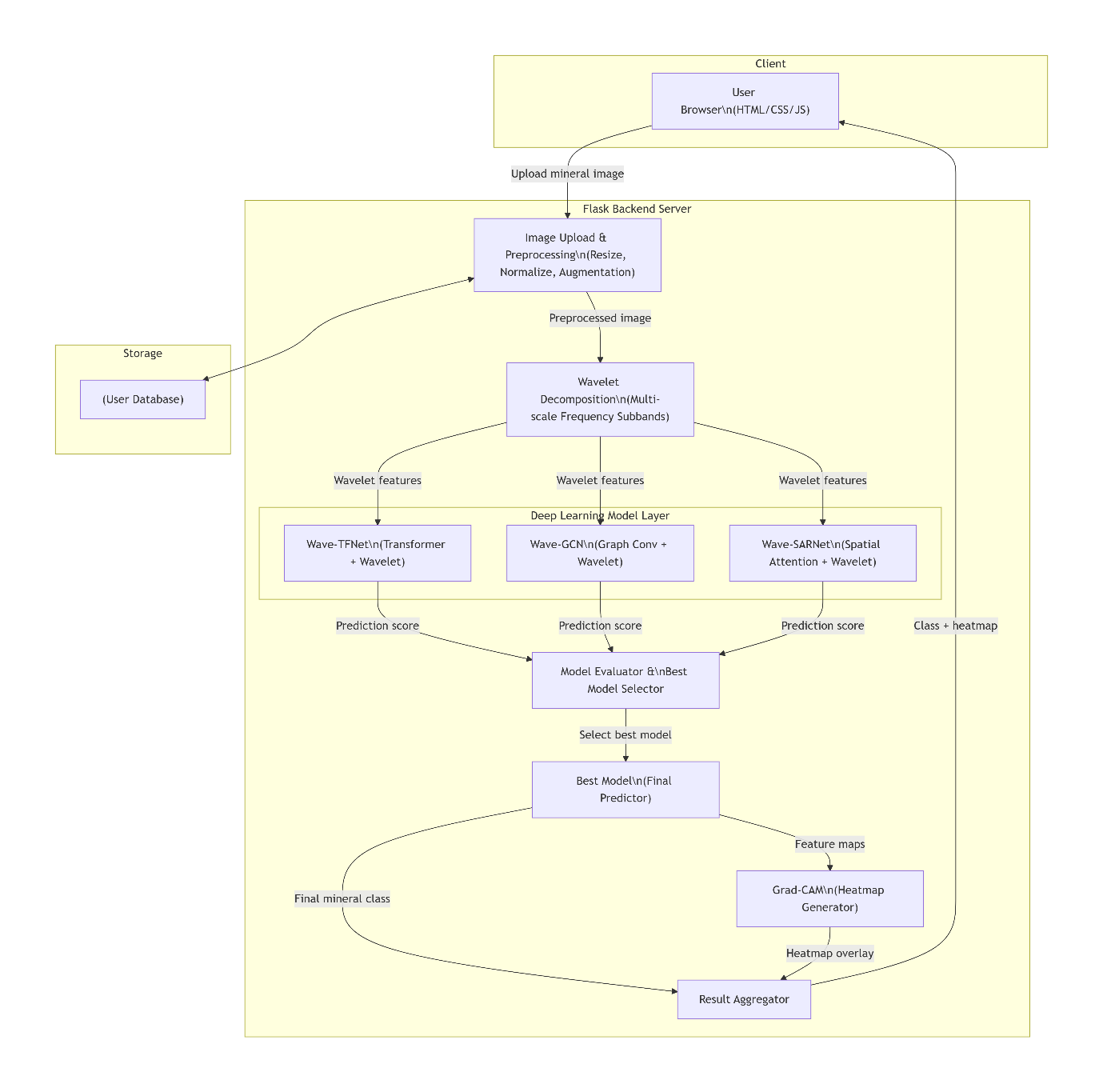
The main objectives of this research are to develop a robust deep learning model for classifying mineral images by utilizing wavelet-enhanced techniques. The model will integrate Wave-TFNet, Wave-GCN, and Wave-SARNet to extract multi-scale features, thereby improving classification accuracy. By leveraging wavelet decomposition, the model will break down images into frequency components, allowing it to capture fine-grained spatial features that traditional CNNs might overlook. To enhance interpretability, Grad-CAM will be implemented to visualize the areas of the image the model focuses on when making predictions, ensuring that the model’s decisions are transparent and trustworthy. The performance of the proposed model will be evaluated on a mineral image dataset using standard classification metrics such as accuracy, precision, recall, and F1-score. The primary goal is to fine-tune and optimize the model to achieve high classification accuracy, surpassing traditional methods in mineral image classification tasks. Additionally, the system will be designed to handle diverse mineral textures, shapes, and lighting conditions, ensuring adaptability across different environments.
Abstract
This project focuses on developing a wavelet-enhanced deep learning model, named WFeedNet, for the classification of mineral images. The model integrates wavelet transforms with deep learning architectures, such as Wave-TFNet, Wave-GCN, and Wave-SARNet, to efficiently process and classify images into mineral types. Wavelet decomposition is applied to the images to extract multi-scale features that enhance the model's ability to identify fine-grained patterns in the images. The deep learning components leverage these features to learn complex relationships within the mineral images. Additionally, Grad-CAM is implemented to visualize the areas of the image that influence the model's decision-making process, providing interpretability to the classification. The proposed model is trained on a dataset containing images of minerals, including Biotite, Bornite, Chrysocolla, and others. The model's performance is evaluated using metrics such as accuracy, precision, recall, and F1-score, demonstrating its capability to achieve high accuracy while offering insights into the decision-making process. This study contributes to improving the classification accuracy of mineral images and offers a more transparent approach to deep learning-based classification tasks.
Keywords: Wavelet Transform, Deep Learning, Mineral Classification, Wave-TFNet, Wave-GCN, Wave-SARNet, Grad-CAM, Image Processing, Feature Extraction, Interpretability.
NOTE: Without the concern of our team, please don't submit to the college. This Abstract varies based on student requirements.
Block Diagram
Specifications
HARDWARE REQUIREMENTS
• Processor - I5/Intel Processor
• RAM - 8GB (min)
• Hard Disk - 160 GB
• Key Board - Standard Windows Keyboard
• Mouse - Two or Three Button Mouse
• Monitor - Any
SOFTWARE REQUIREMENS
• Operating System : Windows 7/8/10
• Server side Script : HTML, CSS, Bootstrap & JS
• Programming Language : Python
• Libraries : Flask, Pandas, Mysql.connector, Os, Numpy,
Scikit-learn.
• IDE/Workbench : VS-Code
• Technology : Python 3.10+
• Server Deployment : Xampp Server
• Database : MySQL


 Paper Publishing

Request Call Back
Would you like to receive a free callback now?
Choose the best time for callback:
Leave your message and we will contact you as soon as possible

6-2-85/B, Old Maternity Hospital Road, Thyagaraja Nagar, Tirupati, Andhra Pradesh – 517501
+91 9030333433
+91 9393939065
0877-2261612

Disclaimer - Takeoff Edu Group Projects are not associated or affiliated with IEEE in any way. The IEEE Projects mentioned here are mentioned in the context of student projects, whose ideas are derived from IEEE publications, not projects of or by IEEE.

