A Unified Power Control Method for Standalone and Grid Connected DFIG-DC System
Objective
Main objective of this project is that the stator frequency can be controlled by the rotating speed of the rotor current vector without calculating stator frequency which can reduce the parameter dependency.
Abstract
In this project, to transfer unified power from grid connected mode to standalone mode without changing control strategy and vice versa, a unified power control method for DFIG-DC system is proposed. There is no need to detect the interconnection switch to identify whether it is grid connected or standalone.
The dc voltage and stator active power are both positive correlations with the magnitude of rotor current vector, which indicates that these two objectives can be combined as the unified power to generate the rotor current reference.
The stator frequency can be controlled by the rotating speed of rotor current vector without calculating stator frequency which can reduce the parameter dependency. The effectiveness of the proposed system is verified by simulation in MATLAB/SIMULINK.
Keywords: unified power, DFIG-DC system, stator active power, dc voltage, of rotor current vector.
NOTE: Without the concern of our team, please don't submit to the college. This Abstract varies based on student requirements.
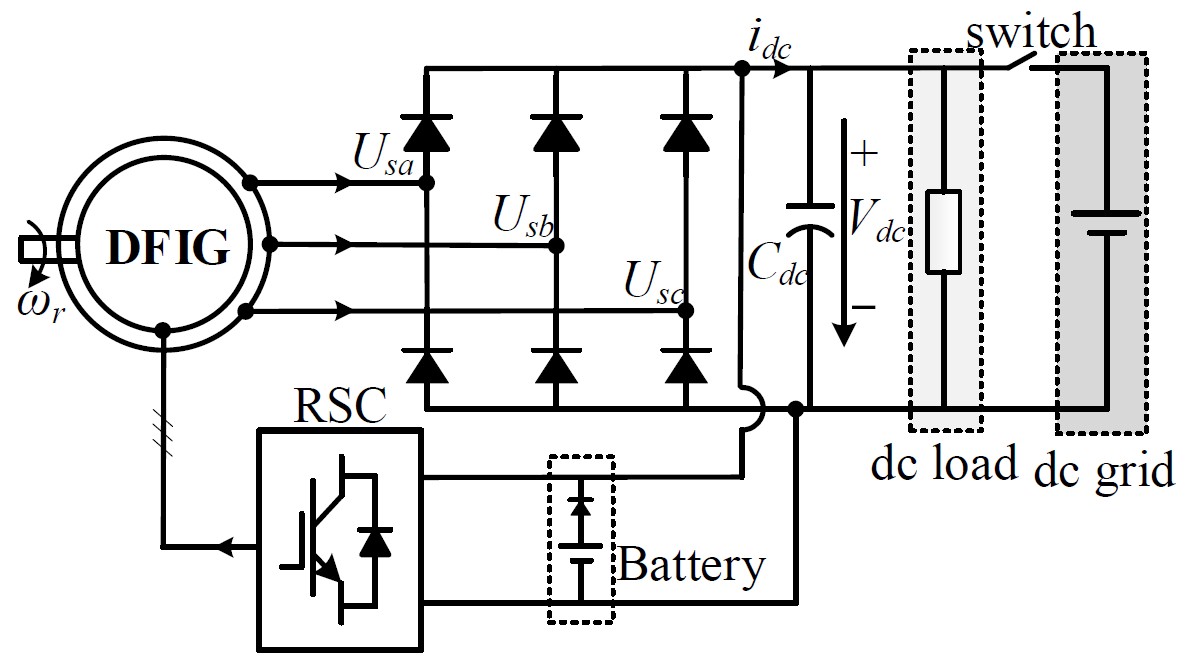
Block Diagram
Specifications
Software Configuration:
Operating System : Windows 7/8/10
Application Software : Matlab/Simulink
Hardware Configuration:
RAM : 8 GB / 4 GB (Min)
Processor : I3 / I5(Mostly prefer)
Learning Outcomes
- Introduction to generators.
- Design of DFIG.
- Introduction to power electronic devices.
- Introduction to power converters.
- Introduction to Pulse Width Modulation techniques.
- Introduction to controllers.
- Design of PI controller.
- Introduction to power quality.
- Introduction to filers.
- Design of filters.
- Introduction to different types of loads.
- Study of unified power control methods.
- Design of unified power control methods.
- Introduction to battery.
- Design of battery.
- Introduction to wind farm.
- Design of wind farm.
- Introduction to different types of loads.
- Design of Power and dc voltage control.
- Design of Stator frequency Control.
- Introduction to park’s transformation.
- Introduction to Clark’s transformation.
- Design of park’s transformation.
- Design of Clark’s transformation.
- Project Development Skills:
- Problem analyzing skills
- Problem solving skills
- Creativity and imaginary skills
- Programming skills
- Deployment
- Testing skills
- Debugging skills
- Project presentation skills
- Thesis writing skills


 Paper Publishing

Request Call Back
Would you like to receive a free callback now?
Choose the best time for callback:
Leave your message and we will contact you as soon as possible

6-2-85/B, Old Maternity Hospital Road, Thyagaraja Nagar, Tirupati, Andhra Pradesh – 517501
+91 9030333433
+91 9393939065
0877-2261612

Disclaimer - Takeoff Edu Group Projects are not associated or affiliated with IEEE in any way. The IEEE Projects mentioned here are mentioned in the context of student projects, whose ideas are derived from IEEE publications, not projects of or by IEEE.

