A Two-Step Time-to-Digital Converter With 5.6-ps Resolution and 1–4255-?s Measurement Range
Objective
Optimize power and area efficiency – The implementation is designed to be power-efficient and compact, making it practical for integration in modern electronic systems.
Abstract
This paper presents a two-step coarse-fine time-to-digital converter (TDC) designed for ultrasonic flowmeter applications. To achieve high resolution using a low-frequency reference clock, a 7.7 MHz reference signal is multiplied by 32 using a multiplying delay-locked loop (MDLL), creating a high-speed internal clock for coarse quantization. The remaining time error after coarse quantization is pulse-stretched and further refined through fine quantization. A cost-effective calibration technique is proposed to enhance the pulse stretching circuit's performance across process, voltage, and temperature (PVT) variations. The TDC is implemented in a 0.11 µm/1.5 V CMOS process, achieving a resolution of 5.6 ps with an input range from 1 µs to 4255 µs. The core TDC circuit occupies 0.065 mm² and consumes 1.8 mW of power. Measured differential nonlinearity (DNL) and integral nonlinearity (INL) are ±3.1 ps and ±59.7 ps, respectively.
Keywords: Time-to-digital converter (TDC), multiplying delay-locked loop (MDLL), pulse stretching, ultrasonic flowmeter.
NOTE: Without the concern of our team, please don't submit to the college. This Abstract varies based on student requirements.
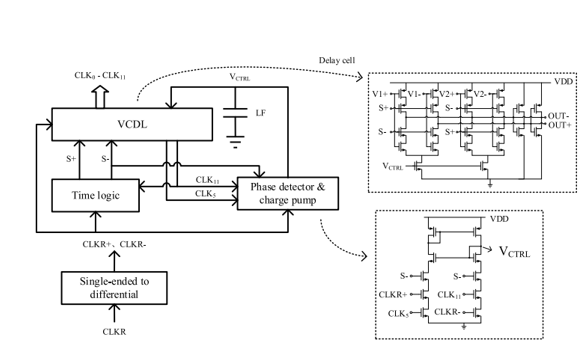
Block Diagram
Specifications
Software Requirements:
- Tool: Cadence Virtuoso
- Technology: GPDK 90 nm
Hardware Requirements:
- Microsoft® Windows XP
- Intel® Pentium® 4 processor or Pentium 4 equivalent with SSE support
- 512 MB RAM
- 100 MB of available disk space
Learning Outcomes
· Introduction to Analog & Digital Electronics
· Amplifier Topology:
· Modifying delay locked loop:
· Time digital convertor Applications:
· Circuit Analysis:
· Basics of vcdl & mdll amplifier:
· Biasing Techniques:
· Signal Integrity:
Demo Video


Request for Video
 Paper Publishing
Request Call Back
Would you like to receive a free callback now?
Choose the best time for callback:
Leave your message and we will contact you as soon as possible

6-2-85/B, Old Maternity Hospital Road, Thyagaraja Nagar, Tirupati, Andhra Pradesh – 517501
+91 9030333433
+91 9393939065
0877-2261612

Disclaimer - Takeoff Edu Group Projects are not associated or affiliated with IEEE in any way. The IEEE Projects mentioned here are mentioned in the context of student projects, whose ideas are derived from IEEE publications, not projects of or by IEEE.

