A TRUSTED LIGHTWEIGHT COMMUNICATION STRATEGY AND A LOCATION AND VELOCITY PREDICTION-ASSISTED FOR FANETS
Objective
Develop a secure and efficient clustering algorithm for Flying Ad hoc Network (FANET), optimizing end-to-end delay, energy consumption, and dishonesty detection in content-centric communication environments with unmanned aerial vehicles (UAVs).
Abstract
Unmanned aerial vehicles (UAVs) are used as communication nodes in the Flying Ad hoc Network (FANET), a new breed of resource-constrained Mobile Ad hoc Network (MANET). These latter offer a broad range of applications and services by adhering to a predetermined route known as their "mission." Without losing any generality, the FANET's services and applications are built around the distribution of data and information in a variety of formats, including but not restricted to images, videos, status updates, warnings, and so forth. FANET therefore requires a content-centric communication method, such as information-centric networking. The issues with the traditional TCP/IP-based Internet are addressed by ICN. Because of their inherent security features and interest/data-based communication, Content-centric networking and Named Data Networking are two of the most well-known and extensively used ICN implementations. Simultaneously, the intermediate UAVs choose whether to check the data authenticity or not, following their subjective belief on its producer’s behavior and thus-forth reducing the computation complexity and delay. Simulation results show that our proposal can sustain the vanilla NDN security levels exceeding the 80% dishonesty detection ratio while reducing the generated end-to-end delay to less than 1 s in the worst case and reducing the average consumed energy by more than two times. Later, we will implement the location and velocity information predicted by the Kalman-filter, we offer a unique FANET clustering algorithm that can effectively create and maintain a hierarchical structure in FANETs when mobile nodes move at high speeds. The number of clusters is first calculated using the Silhouette coefficient, and nodes are then grouped into clusters using the k-means++ technique. In highly mobile environments, a Kalman filter is used to anticipate the locations and velocities of each node with respect to external disturbances. Relative distances and speeds are taken into account for clustering, and the previously chosen cluster heads (CHs) are used to initialize the current centroids.
Keywords: FANET Communications, Network Clustering, Kalman Filter Prediction, K-means Algorithm, Cluster Stability Metric, NDN, VANET, Trust, Energy Efficiency.
NOTE: Without the concern of our team, please don't submit to the college. This Abstract varies based on student requirements.
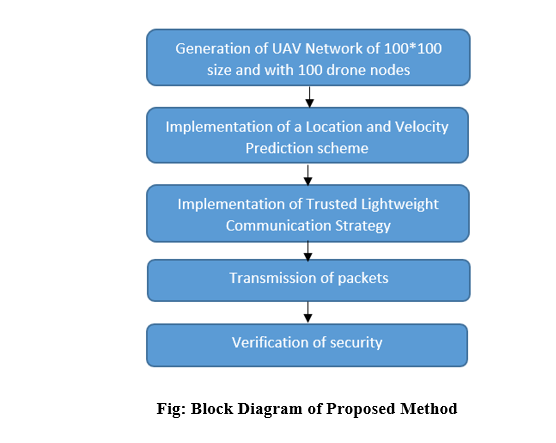
Block Diagram
Specifications
Software: Matlab 2020a or above
Hardware:
Operating Systems:
- Windows 10
- Windows 7 Service Pack 1
- Windows Server 2019
- Windows Server 2016
Processors:
Minimum: Any Intel or AMD x86-64 processor
Recommended: Any Intel or AMD x86-64 processor with four logical cores and AVX2 instruction set support
Disk:
Minimum: 2.9 GB of HDD space for MATLAB only, 5-8 GB for a typical installation
Recommended: An SSD is recommended A full installation of all MathWorks products may take up to 29 GB of disk space
RAM:
Minimum: 4 GB
Recommended: 8 GB
Learning Outcomes
· Introduction to Matlab
· What is EISPACK & LINPACK
· How to start with MATLAB
· About Matlab language
· Matlab coding skills
· About tools & libraries
· Application Program Interface in Matlab
· About Matlab desktop
· How to use Matlab editor to create M-Files
· Features of Matlab
· Basics on Matlab
· What is Communication?
· About Communication
· Introduction to Communication
· How Communication Works?
· Importing the System Design, Characterization and Visualization
· Analyzing of BER tool
· Analyzing of Error Rate Test Console
· Generation of WSN
· WSN network creation
· Nodes Communication
· Clustering
· Routing
· Convolutional
· Equalization and Synchronization etc.,
· How to extend our work to another real time applications
· Project development Skills
o Problem analyzing skills
o Problem solving skills
o Creativity and imaginary skills
o Programming skills
o Deployment
o Testing skills
o Debugging skills
o Project presentation skills
o Thesis writing skills


 Paper Publishing

Request Call Back
Would you like to receive a free callback now?
Choose the best time for callback:
Leave your message and we will contact you as soon as possible

6-2-85/B, Old Maternity Hospital Road, Thyagaraja Nagar, Tirupati, Andhra Pradesh – 517501
+91 9030333433
+91 9393939065
0877-2261612

Disclaimer - Takeoff Edu Group Projects are not associated or affiliated with IEEE in any way. The IEEE Projects mentioned here are mentioned in the context of student projects, whose ideas are derived from IEEE publications, not projects of or by IEEE.

