A Transparent Proximity Coupled Fed Patch Antenna with Enhanced Bandwidth and Filtering Response
Abstract
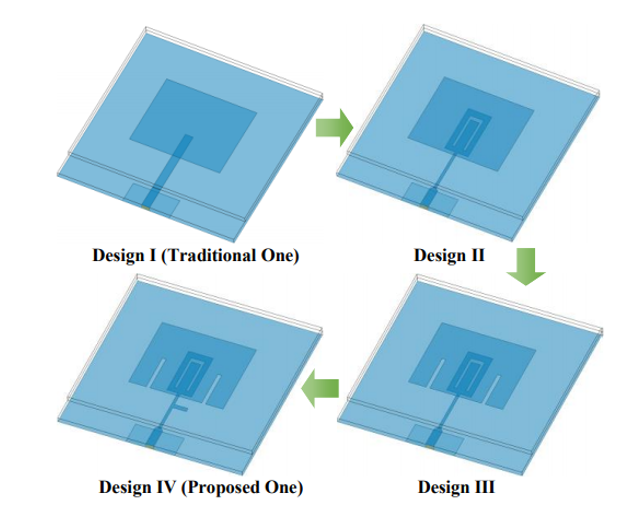
This paper introduces a novel transparent proximity-coupled-fed patch antenna with enhanced impedance bandwidth and good filtering response. The proposed antenna consists of a ground plane, a specific feeding structure, and a slotted patch. All the conducting surfaces are realized with silver meshes printed on glass substrates. Optical transparency of the antenna depends on the mesh density. The feed line of a traditional proximity-coupled-fed patch antenna is terminated with a driven stub etched with a half-wavelength U-shaped slot. This modification introduces an additional resonant mode but also a radiating null. By further etching a pair of quarter-wavelength open slots on the radiating patch, another resonant mode accompanied with an extra radiation null is generated. Finally, three resonant modes within the operating band along with two radiation nulls near the two edges of the pass band are achieved.
Keywords: Transparent antenna, filtering antenna, proximity coupled fed, Bandwidth enhancement.
NOTE: Without the concern of our team, please don't submit to the college. This Abstract varies based on student requirements.
Block Diagram
Specifications
Software: HFSS Antenna designing.
Hardware:
- 64-bit Intel or AMD system, running Windows 10.
- 8 GB RAM
- A dedicated graphics card with latest drivers and at least 1GB video RAM, capable of supporting OpenGL 4.5 and DirectX 11, or higher. Use of integrated graphics (e.g., Intel HD/IRIS) is not recommended and is not support by the Analyze stage in Discovery. See below for special graphics requirements for ANSYS Discovery Live.
- 3 button Mouse.
Learning Outcomes
- Introduction to HFSS
- What is Antenna designing
- How to start with HFSS antenna designing.
- About Electromagnetic environmental setup
- Designing skills
- About libraries
- How to add feed, radiation patterns for Antenna.
- About HFSS desktop
- How to use different shapes in creation of Antenna
- Features of HFSS
- Basics on HFSS
- How to create EM fields in HFSS.
- How to generate directive gain, return loss graphs for different frequencies.
- How to extend our work to another real time applications
- Project development Skills
- Problem analyzing skills
- Problem solving skills
- Creativity and imaginary skills
- Programming skills
- Deployment
- Testing skills
- Debugging skills
- Project presentation skills
- Thesis writing skills


 Paper Publishing

Request Call Back
Would you like to receive a free callback now?
Choose the best time for callback:
Leave your message and we will contact you as soon as possible

6-2-85/B, Old Maternity Hospital Road, Thyagaraja Nagar, Tirupati, Andhra Pradesh – 517501
+91 9030333433
+91 9393939065
0877-2261612

Disclaimer - Takeoff Edu Group Projects are not associated or affiliated with IEEE in any way. The IEEE Projects mentioned here are mentioned in the context of student projects, whose ideas are derived from IEEE publications, not projects of or by IEEE.

