A Three-tier Architecture For Securing Iov Communications Using Vehicular Dependencies
Abstract
A Three-Tier Architecture for Securing IoV Communications using Vehicular Dependencies
Abstract:
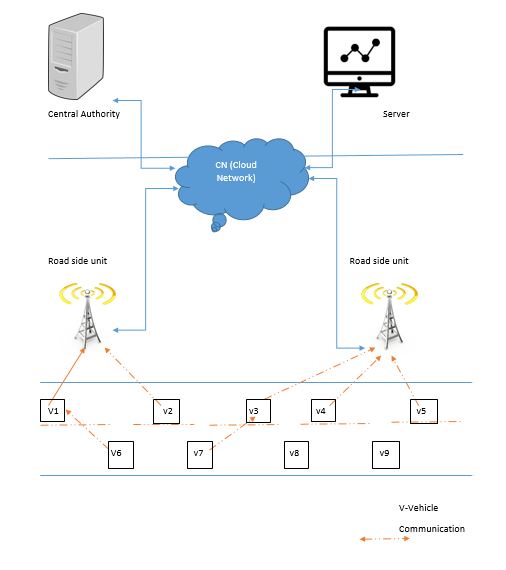
Internet of Vehicles (IoV) incorporates environmental entities and networks for information exchange and service provisioning in road-side communications. Smart vehicles assisted communications are exposed to higher risks as they communicate using wireless medium. Denial of service (DoS) types of attack gain control over the wireless medium to isolate resources and services to the end-users. Reputation-based vehicle assisted communication (RVAC) proposed in this manuscript mitigates DoS attack by using global and local dependencies of the vehicles. Global and local dependencies are modeled by observing the transmission attributes associated with the vehicles. To ease adversary mitigation, the process of assessing vehicle attributes and decision making are distributed across three tiers, categorized in the IoV architecture. Central Authority (CA) works in a co-operative manner with the road-side units (RSUs) to ensure only legitimate vehicles participate in the communication process. The efficiency of the proposed RVAC is assessed and verified through extensive simulation results. RVAC performance is evaluated based upon detection time, communication loss, delay, false positive factor, and vehicle selection. The impact of vehicle density and adversary ratio are considered in the performance evaluation. Experimental results illustrate that the proposed RVAC retains a high reputed vehicle selection rate with fewer false positives, less communication loss, and shorter communication delay and detection time.
NOTE: Without the concern of our team, please don't submit to the college. This Abstract varies based on student requirements.
Block Diagram
Specifications


 Paper Publishing

Request Call Back
Would you like to receive a free callback now?
Choose the best time for callback:
Leave your message and we will contact you as soon as possible

6-2-85/B, Old Maternity Hospital Road, Thyagaraja Nagar, Tirupati, Andhra Pradesh – 517501
+91 9030333433
+91 9393939065
0877-2261612

Disclaimer - Takeoff Edu Group Projects are not associated or affiliated with IEEE in any way. The IEEE Projects mentioned here are mentioned in the context of student projects, whose ideas are derived from IEEE publications, not projects of or by IEEE.

