A Study on Dimensionality Reduction in PCA Algorithm
Objective
In this paper, we have measured a calculation utilizing Principal Component Analysis (PCA) for its application in information analysis.
Abstract
In
this project, we have measured a calculation utilizing Principal Component
Analysis (PCA) for its application in information analysis. In the inspection field,
it is hard to comprehend the enormous measure of information and is very
tedious as well. This way, to maintain a tactical distance from consumption of
time and for the simplicity in understanding, we have investigated a PCA
calculation that can diminish the immense element of the information into
2-dimensional. The performance for PCA is operated to pack the most extreme
measure of data into initial two segments of the changed network known as the
principal components by dismissing the other vectors that convey the irrelevant
data or repetitive information. The primary target of the paper is to separate
two mixes state A and B having various focuses for every one of the four
devices also, distinguishes which sensors have the relative or exclusive focus
with the assistance of different plots that clarifies the connection between
the various factors.
NOTE: Without the concern of our team, please don't submit to the college. This Abstract varies based on student requirements.
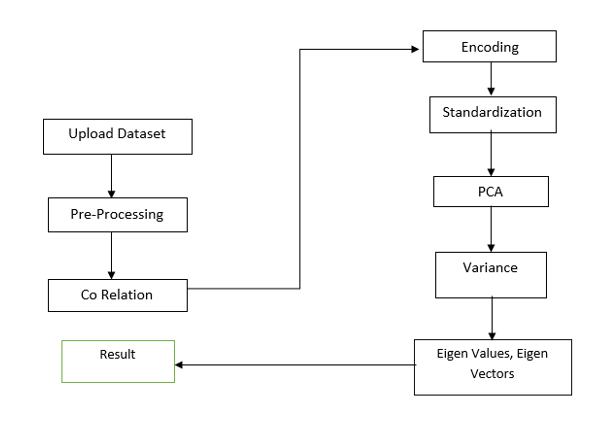
Block Diagram
Specifications
HARDWARE SPECIFICATIONS:
- Processor: I3/Intel
- Processor RAM: 4GB (min)
- Hard Disk: 128 GB
- Key Board: Standard Windows Keyboard
- Mouse: Two or Three Button Mouse
- Monitor: Any
SOFTWARE SPECIFICATIONS:
- Operating System: Windows 7+
- Server-side Script: Python 3.6+
- IDE: Jupyter Notebook
- Libraries Used: Pandas, Numpy.
Learning Outcomes
- About Python.
- About PyCharm.
- About Pandas.
- About Numpy.
- About Sklearn.
- About Machine Learning.
- About Artificial Intelligent.
- About how to use the libraries.
- Cloud Overview.
- Virtualization.
- About how to create the registration table in sql.
- About model choosing.
- About how to generate the predictions with python code.
- Project Development Skills:
- Problem analyzing skills.
- Problem solving skills.
- Creativity and imaginary skills.
- Programming skills.
- Deployment.
- Testing skills.
- Debugging skills.
- Project presentation skills.
- Thesis writing skills.


 Paper Publishing

Request Call Back
Would you like to receive a free callback now?
Choose the best time for callback:
Leave your message and we will contact you as soon as possible

6-2-85/B, Old Maternity Hospital Road, Thyagaraja Nagar, Tirupati, Andhra Pradesh – 517501
+91 9030333433
+91 9393939065
0877-2261612

Disclaimer - Takeoff Edu Group Projects are not associated or affiliated with IEEE in any way. The IEEE Projects mentioned here are mentioned in the context of student projects, whose ideas are derived from IEEE publications, not projects of or by IEEE.

