A Study on Deep Learning based Cyber-bullying Detection Framework for Online Social Networks
Objective
The specific aims of this study are to explore the characteristic of people involved in cyber bullying and to clarify the measurements instruments will lead to consistent evidence-based evaluation of cyber bullying on social media. Here we have taken the hate speech like aggressive, rude or offensive text to classify using machine learning.
Abstract
Cyberbullying is the use of technology as a medium to bully someone. Although it has been an issue for man-years, the recognition of its impact on young people has recently increased. Social networking sites provide a fertile medium for bullies, and teens and young adults who use these sites are vulnerable to attacks. Through machine learning, we can detect language patterns used by bullies and their victims, and develop rules to automatically detect cyberbullying content. Over the last decade, social media has acquired a lot of traction, both positively and negatively way. With the fast growth of social networking, People can communicate with one other via platforms and websites. Directly with no cultural or economic barriers While There have been several advantages to using social media, yet there are none.less negative societal effects One such issue that has arisen is Hate speech has been more prevalent in recent years. Hateful speeches essentially the use of rude and abusive words. using social media It might relate to anybody or something specific. a collection of people who have common interests. In this study, we introduced our approach to dealing with hate speech and, to a considerable part, decreasing it. People express their hatred and rage on social media right instantly, which hurts the sentiments of others. To eradicate hate speech, we dug deep into natural language processing and employed several machine learning models to choose which one to deploy based on accuracy.
Keywords: Natural Language Processing, Classification Technique and Logistic Regression, CNN and Naïve Bayes Classification
NOTE: Without the concern of our team, please don't submit to the college. This Abstract varies based on student requirements.
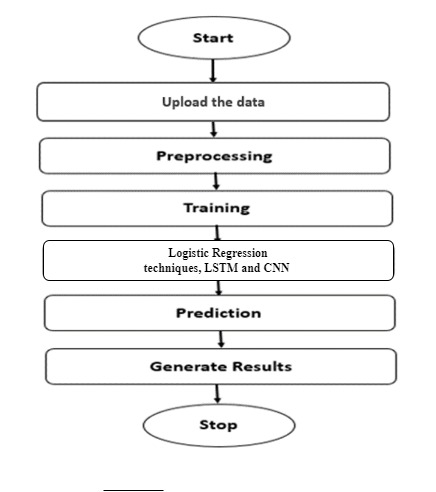
Block Diagram
Specifications
H/W Configuration:
- Operating system: Windows 7 or 7+
- RAM : 8 GB
- Hard disc or SSD: More than 500 GB
- Processor : Intel 3rd generation or high or Ryzen with 8 GB Ram
S/W Configuration:
- Software’s: Python 3.6 or high version
- IDE: PyCharm.
- Framework: Flask
Learning Outcomes
· About Python.
· About PyCharm.
· About Pandas.
· About Numpy.
· About HTML.
· About CSS.
About JavaScript.


 Paper Publishing

Request Call Back
Would you like to receive a free callback now?
Choose the best time for callback:
Leave your message and we will contact you as soon as possible

6-2-85/B, Old Maternity Hospital Road, Thyagaraja Nagar, Tirupati, Andhra Pradesh – 517501
+91 9030333433
+91 9393939065
0877-2261612

Disclaimer - Takeoff Edu Group Projects are not associated or affiliated with IEEE in any way. The IEEE Projects mentioned here are mentioned in the context of student projects, whose ideas are derived from IEEE publications, not projects of or by IEEE.

