A Step Toward Instrument-Agnostic Plankton Classification in the Shared Label Space of IFCB and FlowCam Data
Objective
The main objective of this project is to develop a deep learning model that can accurately classify plankton into ten distinct categories. It aims to leverage EfficientFuzeNET for better feature extraction and improved prediction. The project focuses on creating a robust system that can handle diverse plankton images from different sources. Ultimately, it seeks to support marine research and biodiversity monitoring by providing reliable plankton identification.
Abstract
This project focuses on automating the classification of plankton images into 10 distinct classes, which is essential for marine research and biodiversity monitoring. The system leverages EfficientFuzeNet, a hybrid deep learning model that combines EfficientNetB0 for transfer learning with custom layers tailored to plankton identification. The model uses transfer learning from ImageNet and fine-tunes its performance using plankton images collected from publicly available datasets. The image dataset includes various plankton species, such as Acantharia Protist, Copepod Calanoid, and Trichodesmium Puff. The system employs a two-phase training strategy—initially freezing the EfficientNetB0 base layers and later fine-tuning them for enhanced accuracy. The output layer uses softmax activation for multi-class classification. This model, once trained, offers a robust, automated solution for real-time plankton classification, providing valuable insights into marine ecosystems. The project aims to reduce the manual effort traditionally required for identifying plankton species while improving classification speed and accuracy. The tool is expected to serve in a variety of ecological research applications, including marine biodiversity monitoring, conservation efforts, and oceanography studies.
Keywords:
Plankton Classification , Deep Learning , EfficientFuzeNet , Transfer Learning, EfficientNetB0 , Multi-Class Classification , CNN (Convolutional Neural Network) , Marine Research , Biodiversity Monitoring , Image Recognition
NOTE: Without the concern of our team, please don't submit to the college. This Abstract varies based on student requirements.
Block Diagram
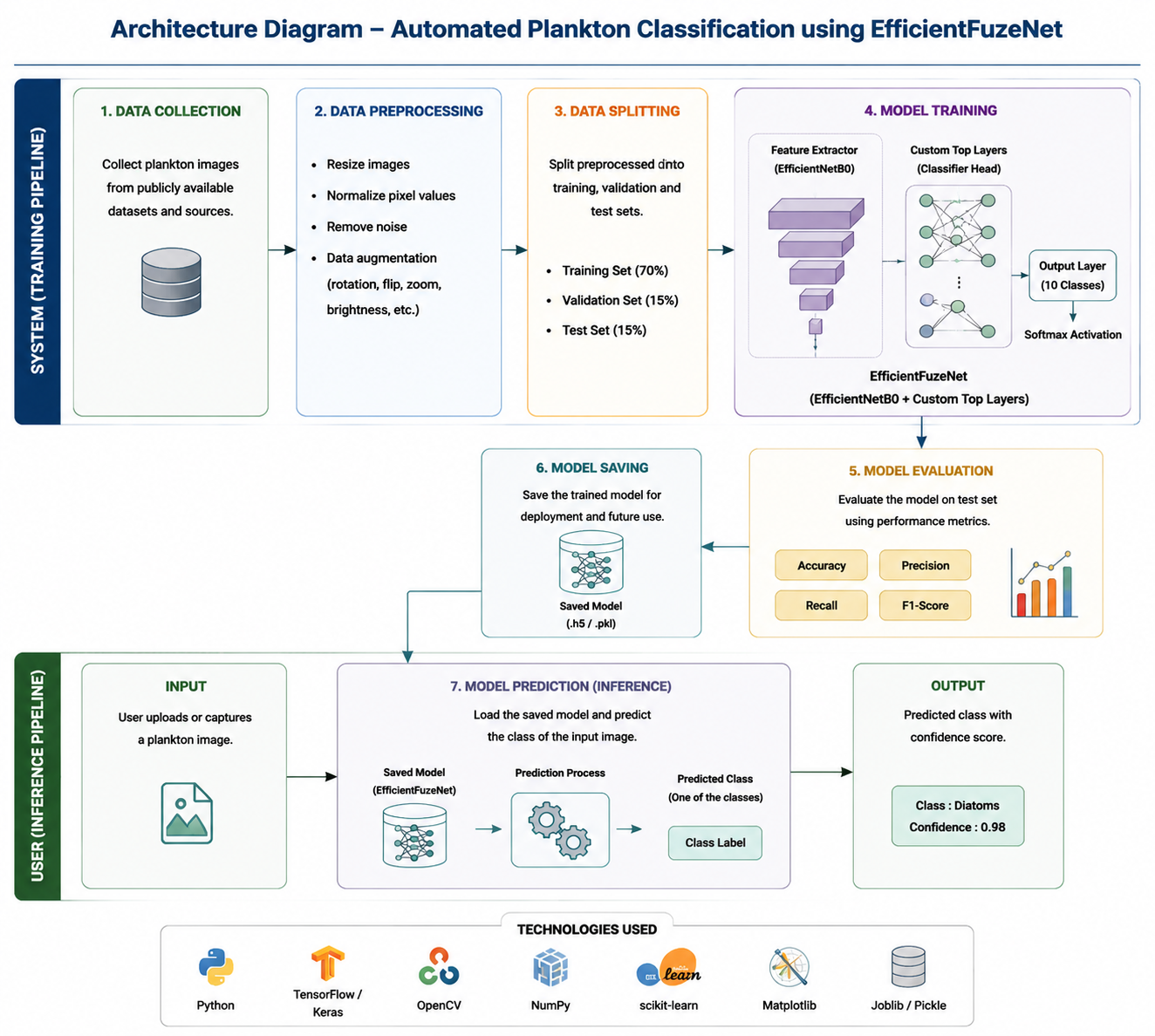
Specifications
4.1 Hardware Requirements
o Processor - I3/Intel Processor
o Hard Disk - 160GB
o Key Board - Standard Windows Keyboard
o Mouse - Two or Three Button Mouse
o Monitor - SVGA
o RAM - 8GB
4.2 Software Requirements:
o Operating System : Windows 7/8/10
o Server side Script : HTML, CSS, Bootstrap & JS
o Programming Language : Python
o Libraries : Flask, Pandas, Mysql.connector, Numpy
o IDE/Workbench : VSCode
o Technology : Python 3.10.8+
o Server Deployment : Xampp Server
o Database : MySQL


 Paper Publishing

Request Call Back
Would you like to receive a free callback now?
Choose the best time for callback:
Leave your message and we will contact you as soon as possible

6-2-85/B, Old Maternity Hospital Road, Thyagaraja Nagar, Tirupati, Andhra Pradesh – 517501
+91 9030333433
+91 9393939065
0877-2261612

Disclaimer - Takeoff Edu Group Projects are not associated or affiliated with IEEE in any way. The IEEE Projects mentioned here are mentioned in the context of student projects, whose ideas are derived from IEEE publications, not projects of or by IEEE.

