A Stacked Machine Learning Approach for HighResolution Urban Water Quality Monitoring
Objective
The primary objective of this project is to develop an intelligent water quality prediction system that can accurately forecast the WQI based on water quality parameters. Specific objectives include: • Hybrid Model Development: Create a hybrid model combining traditional machine learning (RF, GB, XGB) and deep learning techniques (MLP, SLP, CNN) for enhanced accuracy. • Real-Time Prediction: Enable real-time prediction of WQI using a user-friendly web interface. • Interpretability: Provide transparency in predictions through feature importance analysis and actionable suggestions based on the predicted WQI values. • Scalable Deployment: Design the system to be adaptable for large-scale environmental monitoring and management.
Abstract
Water quality is a critical parameter for human health, agriculture, and aquatic ecosystems. Accurate and timely prediction of the water quality index (WQI) enables effective water resource management and proactive measures for contamination control. This study proposes a hybrid deep learning framework that combines multiple approaches for improved WQI prediction. The framework includes a hybrid stacking ensemble of Random Forest (RF), Gradient Boosting (GB), XGBoost (XGB), and Multilayer Perceptron (MLP), as well as deep learning models such as MLP + Single-Layer Perceptron (SLP) + CNN and MLP + SLP + Deep CNN. The hybrid deep learning models leverage the complementary strengths of each architecture: MLP captures nonlinear interactions among features, SLP ensures generalization, and CNNs extract local correlations and patterns across sequential or structured features. A dataset containing physicochemical attributes such as water speed, direction, chlorophyll, temperature, dissolved oxygen, pH, salinity, and turbidity is utilized. Models are trained and validated on real-time measurements and evaluated through standard metrics including Mean Squared Error (MSE), Mean Absolute Error (MAE), and R² score. Results indicate that the hybrid approaches outperform individual models, achieving superior accuracy and reliability in WQI prediction. The framework also provides interpretability through feature importance analysis and generates actionable suggestions based on predicted water quality categories, ranging from excellent to poor. These methods demonstrate significant potential for environmental monitoring and decision support in water quality management. Future work may integrate satellite and IoT sensor data for enhanced predictive capabilities.
Keywords: Water Quality Index, Hybrid Stacking, Deep Learning, MLP, CNN, SLP, RF, GB, XGB, Prediction, Feature Importance, Environmental Monitoring
NOTE: Without the concern of our team, please don't submit to the college. This Abstract varies based on student requirements.
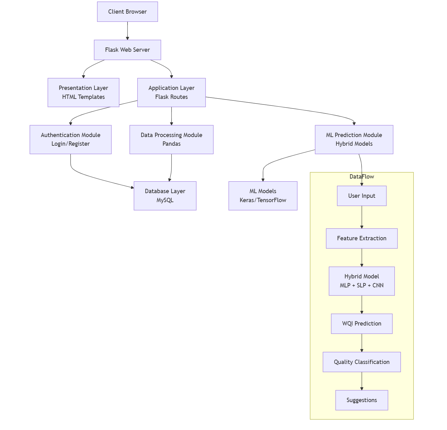
Block Diagram
Specifications
SOFTWARE REQUIREMENS
Operating System : Windows 7/8/10
Server side Script : HTML, CSS, Bootstrap & JS
Programming Language : Python
Libraries : Flask, Pandas, Torch, Keras, Sklearn, Numpy , Seaborn
IDE/Workbench : VSCODE
Server Deployment : Xampp Server
Database : MySQL
HARDWARE REQUIREMENTS
Processor - I3/Intel Processor
RAM - 8GB (min)
Hard Disk - 128 GB
Key Board - Standard Windows Keyboard
Mouse - Two or Three Button Mouse
Monitor - Any


 Paper Publishing

Request Call Back
Would you like to receive a free callback now?
Choose the best time for callback:
Leave your message and we will contact you as soon as possible

6-2-85/B, Old Maternity Hospital Road, Thyagaraja Nagar, Tirupati, Andhra Pradesh – 517501
+91 9030333433
+91 9393939065
0877-2261612

Disclaimer - Takeoff Edu Group Projects are not associated or affiliated with IEEE in any way. The IEEE Projects mentioned here are mentioned in the context of student projects, whose ideas are derived from IEEE publications, not projects of or by IEEE.

