A Spatial Attention and Multi-Scale Fusion Model for Enhanced Eye Disease Classification with Explainable AI
Objective
This project aims to develop a deep learning framework, AFA-Net, for accurate classification of eye diseases from fundus images by integrating spatial and frequency attention mechanisms. It includes preprocessing, data augmentation, and multi-scale feature extraction to improve model performance and generalization. Additionally, a web-based platform enables user interaction, disease classification, and scalable support for healthcare professionals.
Abstract
Eye diseases lead to vision impairment if not detected early. Fundus imaging provides a non-invasive method for diagnosis, but manual interpretation requires specialized expertise and is time-consuming. This project presents an automated classification pipeline using public fundus images across four disease categories. Two novel hybrid models are proposed. LightEyeNetTransformer integrates a Swin Transformer backbone for global contextual processing, Atrous Spatial Pyramid Pooling for multi-scale lesion extraction, and Efficient Channel Attention for channel-wise feature refinement. SANO-Net is a Transformer-based architecture employing cross-scale gating and dynamic feature fusion to capture lesions of varying dimensions. Class imbalance is addressed through stratified train-validation-test splits and class-weighted loss functions. For interpretability, Grad-CAM++ generates visual heatmaps highlighting regions that influence model decisions. A web-based interface built with HTML, CSS, JavaScript, Python, and Flask includes modules for home, about, registration, login, prediction, and logout. The system provides classification outputs alongside explainability maps.
Keywords: Eye disease classification, fundus images, Swin Transformer, ASPP, ECA attention, SANO-Net, cross-scale gating, dynamic feature fusion, Grad-CAM++, explainable AI.
NOTE: Without the concern of our team, please don't submit to the college. This Abstract varies based on student requirements.
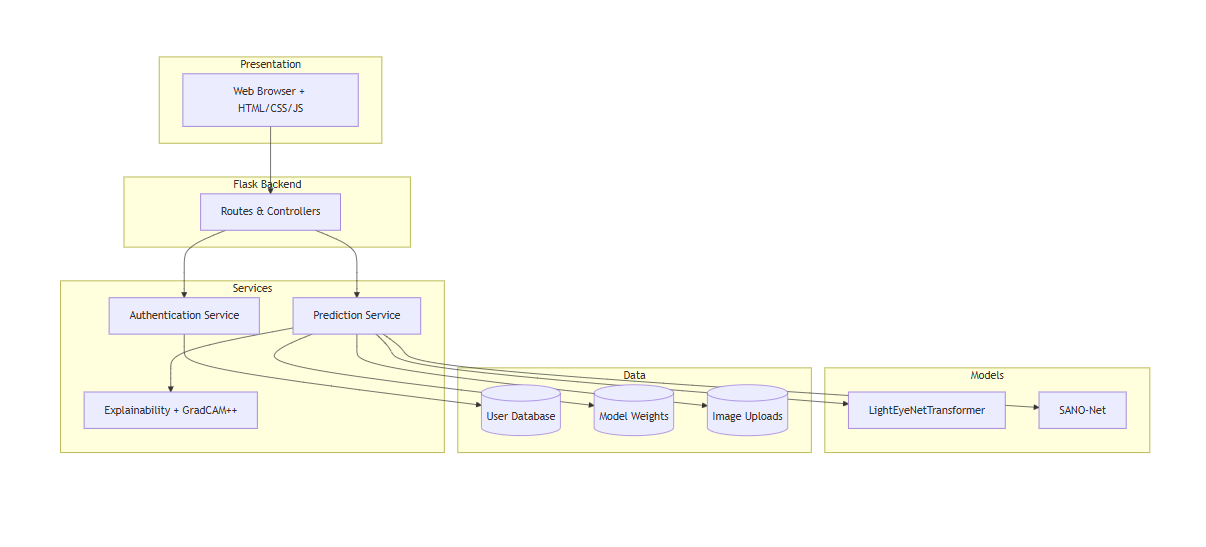
Block Diagram
Specifications
4.3 Hardware Requirements
Processor - I3/Intel Processor
Hard Disk - 160GB
Key Board - Standard Windows Keyboard
Mouse - Two or Three Button Mouse
Monitor - SVGA
RAM - 8GB
4.4 Software Requirements
Operating System : Windows 7/8/10
Programming Language : Python
Libraries : Pandas, Numpy, scikit-learn.
IDE/Workbench : Visual Studio Code.
Framework : Flask


 Paper Publishing

Request Call Back
Would you like to receive a free callback now?
Choose the best time for callback:
Leave your message and we will contact you as soon as possible

6-2-85/B, Old Maternity Hospital Road, Thyagaraja Nagar, Tirupati, Andhra Pradesh – 517501
+91 9030333433
+91 9393939065
0877-2261612

Disclaimer - Takeoff Edu Group Projects are not associated or affiliated with IEEE in any way. The IEEE Projects mentioned here are mentioned in the context of student projects, whose ideas are derived from IEEE publications, not projects of or by IEEE.

