A Solar Panel Fault Detection Deep Learning Model-DL
Objective
This study aims to develop a deep learning model for automated solar panel fault detection across six conditions, comparing architectures like CNN and MobileNetV3 to achieve high accuracy, reduce manual inspections, and support scalable, real-time photovoltaic system monitoring.
Abstract
This study presents a deep learning-based approach for fault detection in solar panels, addressing the critical need for efficient maintenance in photovoltaic systems. Leveraging a comprehensive dataset of solar panel images, we classify six distinct conditions: Bird-drop, Clean, Dusty, Electrical-damage, Physical-Damage, and Snow-Covered. We evaluate multiple deep learning models, including Convolutional Neural Networks (CNN), DenseNet, MobileNetV3, VGG19, Inception V3, and RegNet, to identify the most effective architecture for accurate fault detection. The dataset, sourced from Kaggle, contains diverse images capturing solar panel conditions, enabling robust model training and evaluation. Each model is trained classification performance, with metrics such as accuracy, precision, recall, and F1-score used for comparison. Our results demonstrate that [model with best performance, e.g., DenseNet,MobilenetV3] achieves superior performance, offering high accuracy and robustness across varied fault types. This approach enhances automated monitoring, reducing manual inspection costs and improving the operational efficiency of solar energy systems. The study highlights the potential of deep learning in renewable energy maintenance, providing a scalable solution for fault detection. Future work will focus on real-time implementation and expanding the dataset for enhanced generalization.
Keywords: Solar Panel, Fault Detection, Deep Learning, CNN, DenseNet, MobileNetV3, VGG19, Inception V3, RegNet, Image Classification, Photovoltaic Systems, Renewable Energy.
NOTE: Without the concern of our team, please don't submit to the college. This Abstract varies based on student requirements.
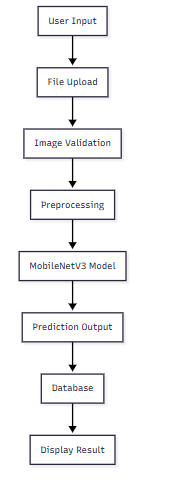
Block Diagram
Specifications
H/W CONFIGURATION:
Processor - I3/Intel Processor
Hard Disk - 160GB
Key Board - Standard Windows Keyboard
Mouse - Two or Three Button Mouse
Monitor - SVGA
RAM - 8GB
S/W CONFIGURATION:
• Operating System : Windows 7/8/10
• Server side Script : HTML, CSS, Bootstrap & JS
• Programming Language : Python
• Libraries : Flask, Pandas, Mysql.connector, Os, Scikit-learn, Numpy
• IDE/Workbench : PyCharm
• Technology : Python 3.6+
• Server Deployment : Xampp Server
Learning Outcomes
H/W CONFIGURATION:
Processor - I3/Intel Processor
Hard Disk - 160GB
Key Board - Standard Windows Keyboard
Mouse - Two or Three Button Mouse
Monitor - SVGA
RAM - 8GB
S/W CONFIGURATION:
• Operating System : Windows 7/8/10
• Server side Script : HTML, CSS, Bootstrap & JS
• Programming Language : Python
• Libraries : Flask, Pandas, Mysql.connector, Os, Scikit-learn, Numpy
• IDE/Workbench : PyCharm
• Technology : Python 3.6+
• Server Deployment : Xampp Server


 Paper Publishing

Request Call Back
Would you like to receive a free callback now?
Choose the best time for callback:
Leave your message and we will contact you as soon as possible

6-2-85/B, Old Maternity Hospital Road, Thyagaraja Nagar, Tirupati, Andhra Pradesh – 517501
+91 9030333433
+91 9393939065
0877-2261612

Disclaimer - Takeoff Edu Group Projects are not associated or affiliated with IEEE in any way. The IEEE Projects mentioned here are mentioned in the context of student projects, whose ideas are derived from IEEE publications, not projects of or by IEEE.

