A Single Network Architecture for Attack Detection and Multi-Class Classification
Objective
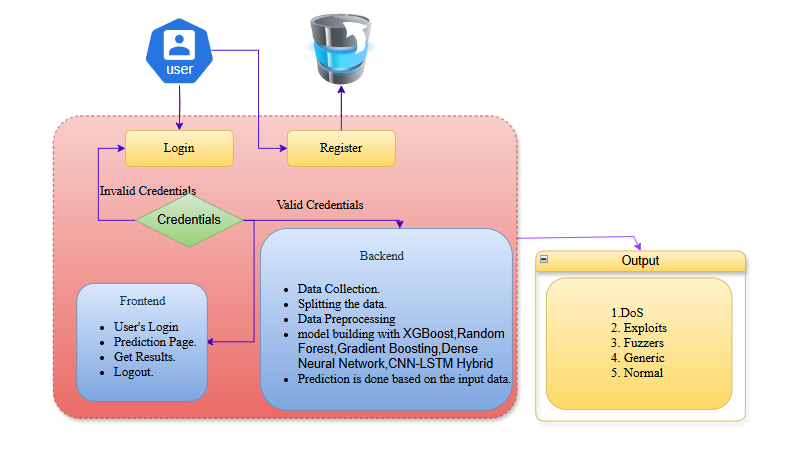
The objective of this project is to develop a unified network architecture that can accurately detect and classify different types of cyberattacks within a network. By leveraging a combination of machine learning algorithms, including XGBoost, Random Forest, Gradient Boosting, Dense Neural Networks, and a CNN-LSTM hybrid model, the project aims to enhance cybersecurity by providing a robust, real-time system for attack detection. The primary goal is to provide automated, multi-class classification of network traffic into five categories: 'DoS', 'Exploits', 'Fuzzers', 'Generic', and 'Normal'. This system will help in early detection of malicious activities, reduce false positives, and improve overall network security performance.
Abstract
The increasing sophistication of cyberattacks in modern networks necessitates robust and adaptable detection mechanisms. This project proposes a unified network architecture for attack detection and multi-class classification, employing a diverse set of machine learning algorithms. The architecture integrates models such as XGBoost, Random Forest, Gradient Boosting, Dense Neural Network, and a CNN-LSTM hybrid approach to detect and classify network intrusions. The target classes include 'DoS', 'Exploits', 'Fuzzers', 'Generic', and 'Normal', covering a broad range of attack categories. The system aims to provide accurate, real-time detection of various types of attacks, utilizing a combination of traditional and deep learning-based algorithms to optimize performance. The proposed multi-model framework capitalizes on the strengths of each algorithm, ensuring high classification accuracy and resilience against a wide array of attack types. The system was implemented in Python using popular machine learning libraries such as scikit-learn for traditional models and Keras for deep learning. By leveraging a comprehensive set of features and multi-class classification, the architecture demonstrates its capability to effectively handle network security threats, offering a scalable solution for attack detection across diverse network environments.
Keywords: Network Security, Attack Detection, Multi-Class Classification, XGBoost, Random Forest, Gradient Boosting, Dense Neural Network, CNN-LSTM Hybrid, Intrusion Detection, Machine Learning, Cybersecurity, Real-Time Detection, Python.
NOTE: Without the concern of our team, please don't submit to the college. This Abstract varies based on student requirements.
Block Diagram
Specifications
SOFTWARE REQUIREMENS
Operating System : Windows 7/8/10
Server side Script : html,css,js
Programming Language : Python
Libraries : Django, Pandas, Torch, Keras, Sklearn,Numpy , Seaborn
IDE/Workbench : VSCode
Server Deployment : Xampp Server
Database : SQLite
HARDWARE REQUIREMENTS
Processor - I3/Intel Processor
RAM - 8GB (min)
Hard Disk - 128 GB
Key Board - Standard Windows Keyboard
Mouse - Two or Three Button Mouse
Monitor - Any

Demo Video


Request for Video
 Paper Publishing
Request Call Back
Would you like to receive a free callback now?
Choose the best time for callback:
Leave your message and we will contact you as soon as possible

6-2-85/B, Old Maternity Hospital Road, Thyagaraja Nagar, Tirupati, Andhra Pradesh – 517501
+91 9030333433
+91 9393939065
0877-2261612

Disclaimer - Takeoff Edu Group Projects are not associated or affiliated with IEEE in any way. The IEEE Projects mentioned here are mentioned in the context of student projects, whose ideas are derived from IEEE publications, not projects of or by IEEE.

