A Sewer Sensor Monitoring System Based On Embedded System
Also Available Domains PIC16F77A|ARM7|Embedded applications
Abstract
India has announced a project of making 100 smart cities. For making a smart city one needs to consider many parameters such as smart water, smart electricity, smart transportation etc. There will be a need of smart underground infrastructure which includes underground water pipelines, communication cables, gas pipelines, electric flow, etc. As most of the cities in India have adopted underground sewerage system, it is very important that this system should work in a proper manner to keep the city clean, safe and healthy. If they fail to maintain the sewerage system the pure water may get contaminated with sewerage water and can spread infectious diseases. So different kind of work has been done to detect, maintain and manage these underground systems. Also, leaks and bursts are unavoidable aspects of water distribution system management and can account for significant water loss within a distribution network if left undetected for long period. This project represents the implementation and design functions for monitoring and managing underground sewerage system with different approaches.
NOTE: Without the concern of our team, please don't submit to the college. This Abstract varies based on student requirements.
Block Diagram
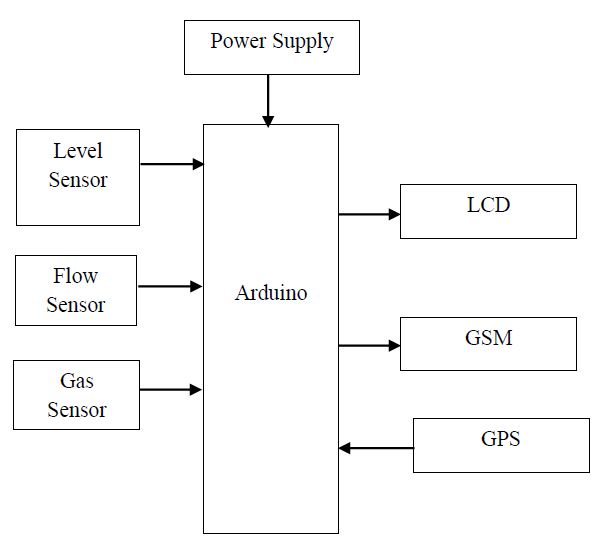
Specifications
Learning Outcomes
- Arduino Pin diagram and Architecture
- How to install Arduino IDE Software
- Setting up and Installation procedures for Arduino IDE
- Introduction to Arduino IDE
- Commands in Embedded C
- How to install Libraries?
- Basic coding in Embedded C
- Working of Flow SENSOR
- How to interface Gas sensor with Arduino
- Working of GSM
- How to interface Gps with Arduino
- Working of LCD
- How to interface LCD with Arduino
- About Project Development Life Cycle:
- Planning and Requirement Gathering (software’s, Tools, Hardware components, etc.,)
- Schematic preparation
- Code development and debugging
- Hardware development and debugging
- Development of the Project and Output testing
- Practical exposure to:
- Hardware and software tools.
- Solution providing for real time problems.
- Working with team/ individual.
- Work on Creative ideas.
- Project development Skills
- Problem analyzing skills
- Problem solving skills
- Creativity and imaginary skills
- Programming skills
- Deployment
- Testing skills
- Debugging skills
- Project presentation skills
- Thesis writing skills


 Paper Publishing

Request Call Back
Would you like to receive a free callback now?
Choose the best time for callback:
Leave your message and we will contact you as soon as possible

6-2-85/B, Old Maternity Hospital Road, Thyagaraja Nagar, Tirupati, Andhra Pradesh – 517501
+91 9030333433
+91 9393939065
0877-2261612

Disclaimer - Takeoff Edu Group Projects are not associated or affiliated with IEEE in any way. The IEEE Projects mentioned here are mentioned in the context of student projects, whose ideas are derived from IEEE publications, not projects of or by IEEE.

