A Robust Deep Learning Model for the Detection of Diseases in Cocos Nucifera
Objective
This project aims to develop a deep learning-based system for accurate detection of diseases in Cocos Nucifera (coconut trees) using advanced image classification techniques. It begins by evaluating established models like EfficientNet, VGGNet, MobileNet, and ResNet for their effectiveness in disease classification. The study proposes novel hybrid models such as CNN-BiLSTM and EEGNet to capture both spatial and temporal features in images. A key contribution is the development of a MobileNet-SVM hybrid model to balance computational efficiency and classification accuracy. The system targets classification of six disease categories: WCLWD_Yellowing, CCI_Caterpillars, Healthy_Leaves, CCI_Leaflets, WCLWD_Flaccidity, and WCLWD_DryingofLeaflets. The goal is to enhance accuracy, robustness, and adaptability in real-world agricultural settings. Ultimately, this automated disease detection system supports early diagnosis, enabling timely intervention and contributing to sustainable agriculture by minimizing coconut crop losses.
Abstract
The detection of diseases in Cocos Nucifera (coconut trees) is essential for maintaining healthy crops and optimizing agricultural practices. In this study, we propose a deep learning-based approach for disease detection, comparing several existing models and introducing novel hybrid models. The existing models include EfficientNet, VGGNet, MobileNet, and ResNet, each known for their performance in image classification tasks. However, these models often struggle to capture intricate temporal and spatial patterns crucial for accurate disease identification in agricultural settings.
To address these limitations, we propose two novel hybrid models: the CNN-BiLSTM Hybrid and EEGNet. The CNN-BiLSTM Hybrid model combines the power of Convolutional Neural Networks (CNNs) for feature extraction and Bidirectional Long Short-Term Memory (BiLSTM) networks for capturing sequential dependencies, enabling the model to better handle variations over time in disease manifestations. EEGNet, originally designed for brainwave signal analysis, is adapted here to leverage its efficient feature extraction and classification capabilities.
Additionally, we explore a hybrid model combining MobileNet with Support Vector Machines (SVM) to enhance classification accuracy, balancing computational efficiency and performance.
The model classifies the following disease categories: WCLWD_Yellowing, CCI_Caterpillars, Healthy_Leaves, CCI_Leaflets, WCLWD_Flaccidity, and WCLWD_DryingofLeaflets. These classes represent various common diseases and conditions affecting coconut trees. The results demonstrate the superiority of the proposed hybrid models over the existing ones, with improved accuracy, robustness, and real-time applicability in agricultural disease monitoring.
This research contributes to the development of automated systems for early disease detection in coconut plantations, facilitating timely intervention and minimizing crop loss.
Keywords: Cocos Nucifera, Deep Learning, Disease Detection, CNN, BiLSTM, EEGNet, Hybrid Models, MobileNet, SVM, Agricultural Monitoring, Image Classification.NOTE: Without the concern of our team, please don't submit to the college. This Abstract varies based on student requirements.
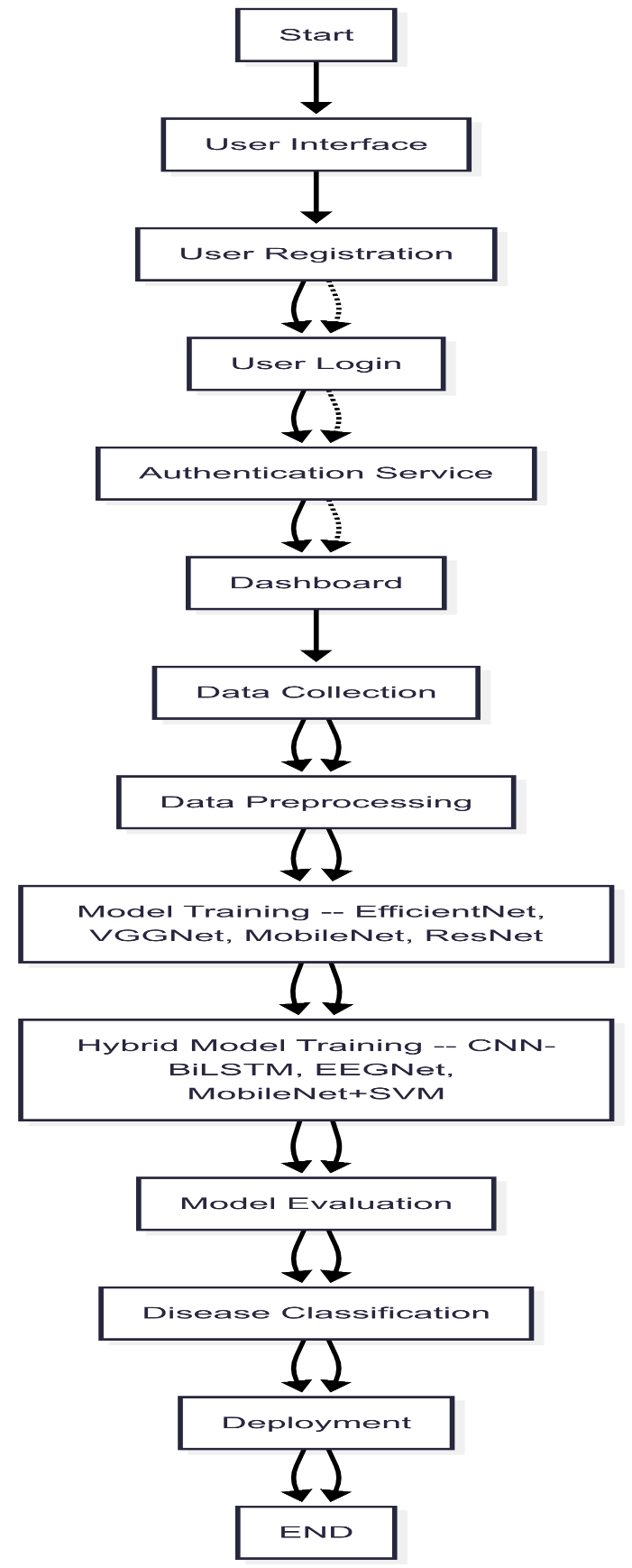
Block Diagram
Specifications
SOFTWARE REQUIREMENS
Operating System : Windows 7/8/10
Server side Script : HTML, CSS, Bootstrap & JS
Programming Language : Python
Libraries Flask, Pandas, Torch, Sklearn, Librosa, Numpy , Seaborn, Matplotlib
IDE/Workbench : VSCode
Server Deployment : Xampp Server
Database : MySQL
HARDWARE REQUIREMENTS
Processor - I3/Intel Processor
RAM - 8GB (min)
Hard Disk - 128 GB
Key Board - Standard Windows Keyboard
Mouse - Two or Three Button Mouse
Monitor - Any

Demo Video


Request for Video
 Paper Publishing
Request Call Back
Would you like to receive a free callback now?
Choose the best time for callback:
Leave your message and we will contact you as soon as possible

6-2-85/B, Old Maternity Hospital Road, Thyagaraja Nagar, Tirupati, Andhra Pradesh – 517501
+91 9030333433
+91 9393939065
0877-2261612

Disclaimer - Takeoff Edu Group Projects are not associated or affiliated with IEEE in any way. The IEEE Projects mentioned here are mentioned in the context of student projects, whose ideas are derived from IEEE publications, not projects of or by IEEE.

