A Robotics-Based Surveillance System for Livestock Wellbeing and Early Disease Detection in Poultry Farms
Objective
The main objective of this project is to implement a robotics-based surveillance system in poultry farms to ensure the wellbeing of livestock and enable early detection of diseases, thereby improving the overall health and productivity of the poultry farm.
Abstract
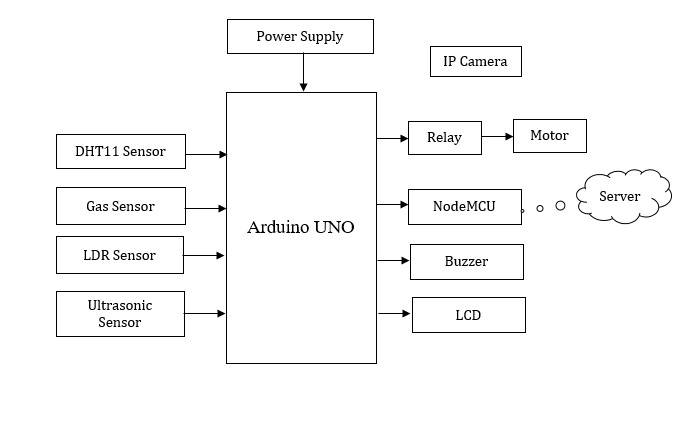
Ensuring the welfare and health of livestock in poultry farms is paramount to maintain high-quality production and animal care standards. This project introduces an innovative Robotics-Based Surveillance System designed to enhance livestock wellbeing and early disease detection in poultry farming environments. Leveraging a combination of Arduino microcontrollers, environmental sensors (DHT11, gas sensor, LDR, ultrasonic sensor), an IP camera, motorized components, NodeMCU for IoT connectivity, and feedback devices like a buzzer and an LCD display, this system offers monitoring and automated responses to improve poultry farm management.
The system continuously collects critical data such as temperature, humidity, gas levels, and ambient light, to detect any deviations from optimal conditions. When anomalies indicative of potential health issues or distress in the flock are detected, the system triggers immediate responses. For instance, the IP camera captures images and video feeds for remote monitoring by farmers and veterinarians. Motors move towards animals. Additionally, the system can provide alerts through a buzzer and display information on an LCD screen for on-site personnel. The incorporation of NodeMCU allows for IoT integration, enabling remote monitoring and data analysis. This system aims to improve poultry farming practices by ensuring the welfare of the livestock and facilitating early disease detection, ultimately contributing to better production outcomes and animal care standards. Further research and field testing will be essential to validate its effectiveness in poultry farming environments.
Keywords: Arduino, NODEMCU, Alerts, IP camera
NOTE: Without the concern of our team, please don't submit to the college. This Abstract varies based on student requirements.
Block Diagram
Specifications
Hardware Components:
- Arduino UNO
- DHT11 Sensor
- Gas Sensor
- LDR
- Ultrasonic Sensor
- IP Camera
- Motors
- Relay
- NodeMCU
- Buzzer
- LCD
Software Components:
- Arduino IDE
- Embedded C
Learning Outcomes
- Arduino pin diagram and architecture
- How to install Arduino IDE software
- Setting up and installation procedure for Arduino
- Introduction to Arduino IDE
- Basic coding in Arduino IDE
- Working of LCD
- Interface LCD with Arduino
- Working of power supply
- About Project Development Life Cycle:
- Planning and Requirement Gathering (software’s, Tools, Hardware components, etc.,)
- Schematic preparation
- Code development and debugging
- Hardware development and debugging
- Development of the Project and Output testing
- Practical exposure to:
- Hardware and software tools.
- Solution providing for real time problems.
- Working with team/ individual.
- Work on Creative ideas.
- Project development Skills
- Problem analyzing skills
- Problem solving skills
- Creativity and imaginary skills
- Programming skills
- Deployment
- Testing skills
- Debugging skills
- Project presentation skills


 Paper Publishing

Request Call Back
Would you like to receive a free callback now?
Choose the best time for callback:
Leave your message and we will contact you as soon as possible

6-2-85/B, Old Maternity Hospital Road, Thyagaraja Nagar, Tirupati, Andhra Pradesh – 517501
+91 9030333433
+91 9393939065
0877-2261612

Disclaimer - Takeoff Edu Group Projects are not associated or affiliated with IEEE in any way. The IEEE Projects mentioned here are mentioned in the context of student projects, whose ideas are derived from IEEE publications, not projects of or by IEEE.

