A Resource-Efficient and High-Accuracy CORDIC-Based Digital Implementation of the Hodgkin–Huxley Neuron
Objective
The primary goal seems to be creating a resource-efficient and high-accuracy digital implementation of the Hodgkin-Huxley neuron model on FPGA platforms 4. This involves addressing several challenges related to the complexity of the Hodgkin-Huxley model and the limitations of FPGA resources.
Abstract
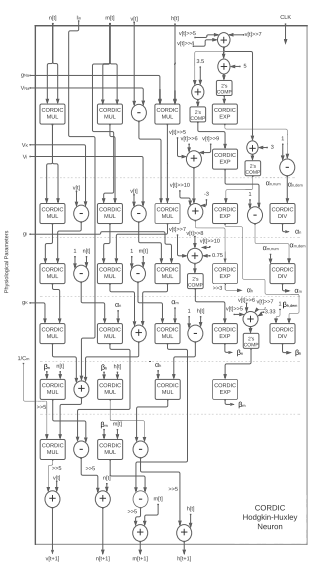
A new and efficient Hodgkin–Huxley (HH) neuron has been implemented on field-programmable gate array (FPGA). Multiplication, division, and exponential terms were implemented using the COordinate Rotation DIgital Computer (CORDIC) algorithm with carefully selected iteration numbers for each operation to greatly reduce the hardware resource requirements while simultaneously maintaining system throughput and a maximum clock frequency of over 275 MHz. The proposed design achieves higher modeling accuracy than previously proposed designs and an accuracy-resource trade-off that represents dramatic improvements. Additionally, all the neuron’s physiological parameters are variable as inputs to the proposed design postimplementation for a high degree of freedom in neuroscientific simulations. The implemented neuron is presented with results, and the behavior of the implemented system is evaluated to verify its close behavioral matching to the target neuron model.
NOTE: Without the concern of our team, please don't submit to the college. This Abstract varies based on student requirements.
Block Diagram
Specifications
Software Requirements:
· Xilinx Vivado Tool
· HDL: Verilog
Hardware Requirements:
· Microsoft® Windows XP
· Intel® Pentium® 4 processor or Pentium 4 equivalent with SSE support
· 512 MB RAM
· 100 MB of available disk space
Learning Outcomes
- Basics of Digital Electronics
- VLSI design Flow
- Introduction to Verilog Coding
- Different modelling styles in Verilog
o Data Flow modelling
o Structural modelling
o Behavioural modelling
o Mixed level modelling
- Introduction to multiplier design
- About Wallace multiplication
- Knowledge on partial product generation and reduction
- Knowledge on adders, compressors
- About approximation computing
- Applications in real time
· Xilinx Vivado for design and simulation
· Generation of Netlist
· Solution providing for real time problems
· Project Development Skills:
o Problem Analysis Skills
o Problem Solving Skills
o Logical Skills
o Designing Skills
o Testing Skills
o Debugging Skills
o Presentation Skills
o Thesis Writing Skills


 Paper Publishing

Request Call Back
Would you like to receive a free callback now?
Choose the best time for callback:
Leave your message and we will contact you as soon as possible

6-2-85/B, Old Maternity Hospital Road, Thyagaraja Nagar, Tirupati, Andhra Pradesh – 517501
+91 9030333433
+91 9393939065
0877-2261612

Disclaimer - Takeoff Edu Group Projects are not associated or affiliated with IEEE in any way. The IEEE Projects mentioned here are mentioned in the context of student projects, whose ideas are derived from IEEE publications, not projects of or by IEEE.

