A Real Time Oil Spill Detection Using Deep Learning
Objective
The primary objective of this project is to develop a deep learning-based system for detecting oil spills in satellite images. By leveraging the YOLOv9 algorithm, the system aims to accurately classify and localize oil spill regions, distinguishing them from visually similar oceanic phenomena such as waves, debris, or algae. This project seeks to provide an efficient and reliable method for monitoring maritime oil spills, supporting environmental protection efforts. Additionally, it aims to minimize false detections, enhance the accuracy of spill identification, and offer actionable insights for authorities to assess and manage oil contamination in marine environments effectively.
Abstract
The increasing frequency of maritime oil spills
poses significant threats to marine ecosystems, necessitating efficient
monitoring and detection methods. This project presents a deep learning-based
approach for identifying oil spills in satellite imagery. Using the YOLOv9
algorithm, the system classifies satellite images into two categories:
"Oil Spill" and "Look-alike," enabling accurate
differentiation between true spills and visually similar phenomena. The model
leverages advanced convolutional architectures to detect and localize spill
regions with high precision, reducing false positives commonly caused by
oceanic features such as waves, debris, or algae. The proposed methodology provides
a robust solution for early identification and assessment of oil spills,
supporting environmental protection agencies and decision-makers in managing
marine contamination events. Experimental results demonstrate the model's
effectiveness in detecting oil spills across diverse maritime conditions,
highlighting its potential to enhance monitoring strategies and mitigate
ecological damage.
Keywords: Oil Spill Detection, Satellite Imagery, Deep Learning, YOLOv9, Image Classification, Marine Environment, Environmental Monitoring, Convolutional Neural Networks, Spill Localization, Look-alike Detections.
NOTE: Without the concern of our team, please don't submit to the college. This Abstract varies based on student requirements.
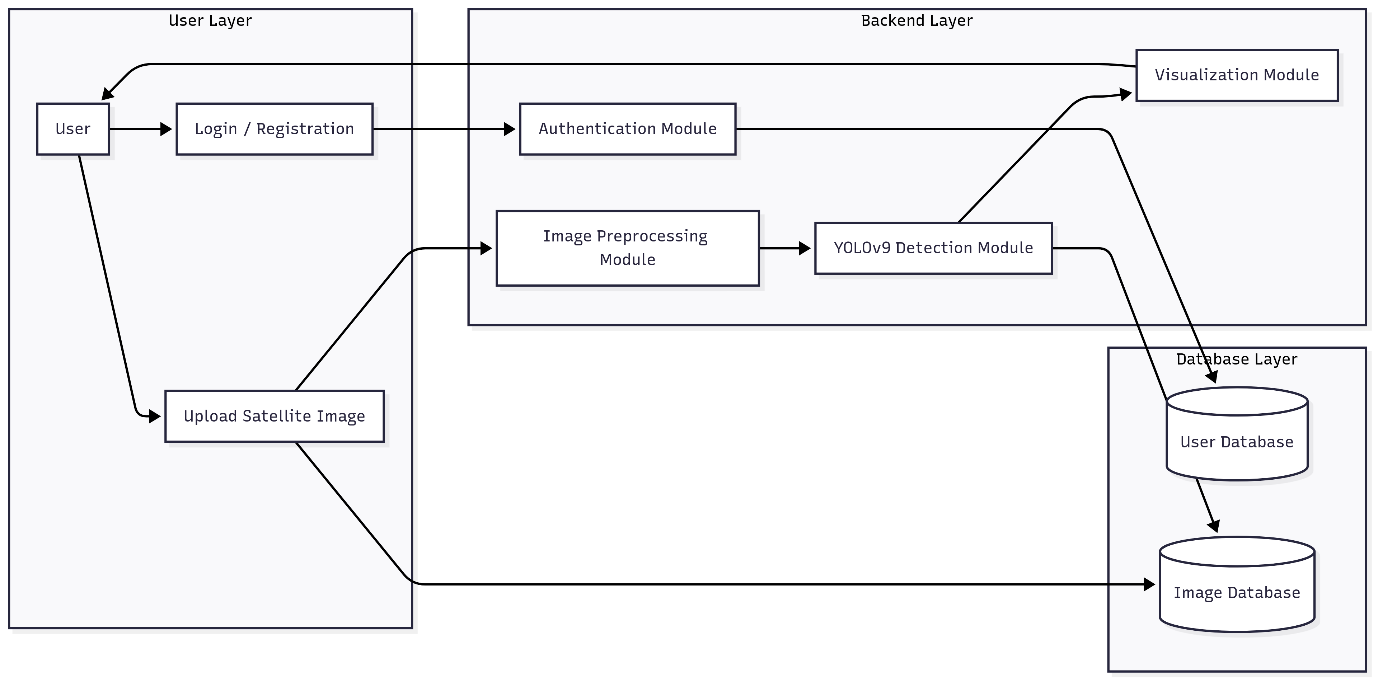
Block Diagram
Specifications
SOFTWARE REQUIREMENS
Operating System : Windows 7/8/10
Server side Script : HTML, CSS, Bootstrap & JS
Programming Language : Python
Libraries :Flask, Pandas, Torch, Sklearn, Librosa,Numpy , Seaborn, Matplotlib
IDE/Workbench : VSCode
Server Deployment : Xampp Server
Database : MySQL
HARDWARE REQUIREMENTS
Processor - I3/Intel Processor
RAM - 8GB (min)
Hard Disk - 128 GB
Key Board - Standard Windows Keyboard
Mouse - Two or Three Button Mouse
Monitor - Any

Demo Video


Request for Video
 Paper Publishing
Request Call Back
Would you like to receive a free callback now?
Choose the best time for callback:
Leave your message and we will contact you as soon as possible

6-2-85/B, Old Maternity Hospital Road, Thyagaraja Nagar, Tirupati, Andhra Pradesh – 517501
+91 9030333433
+91 9393939065
0877-2261612

Disclaimer - Takeoff Edu Group Projects are not associated or affiliated with IEEE in any way. The IEEE Projects mentioned here are mentioned in the context of student projects, whose ideas are derived from IEEE publications, not projects of or by IEEE.

