A Real-time Flood Alert System For Parking Lots
Abstract
Floods are a constant threat throughout the year. Although there are various methods of alerts available; such as the Emergency Broadcast System or sirens, none of these can alert a user remotely in an ef?cient and timely manner. The design goal of this project is to provide a real-time system able to monitor sudden ?oods in parking lots, addressing the concern of water damage to vehicles; creating a personal opt-in alert that could reach an end-user through their mobile phone. In this case, the system de?nes two types of nodes: Sensing and Sink. Each sensing node uses a hydrostatic pressure sensor to monitor the water levels; it will then communicate with neighboring nodes via XBee radios until the data reaches the sink node. The sink node is then responsible for sending the received data from the sensors to a remote server via the mobile communications network (GSM). An up to date database of users and ?ood levels will then be processed and handled by the server, which will send users an email alert that will reach any mobile phone as a text message (SMS).
NOTE: Without the concern of our team, please don't submit to the college. This Abstract varies based on student requirements.
Block Diagram
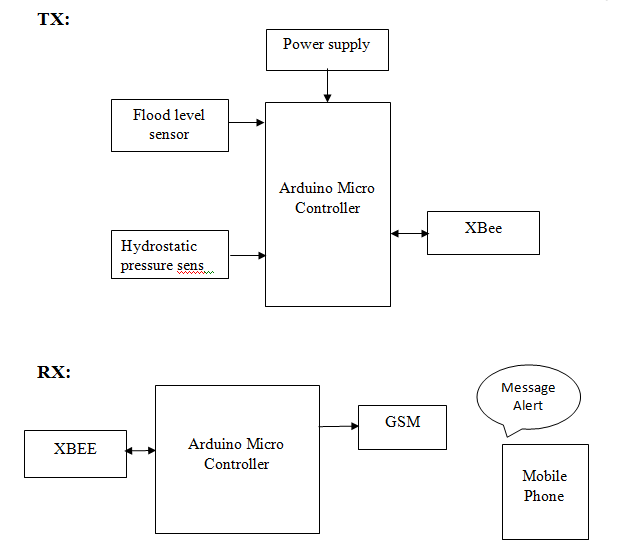
Specifications
Learning Outcomes
- Arduino Pin diagram and Architecture
- How to install Arduino IDE Software
- Setting up and Installation procedures for Arduino IDE
- Introduction to Arduino IDE
- Commands in Embedded C
- How to install Libraries?
- Basic coding in Embedded C
- Working of Zigbee
- Working of Flood level sensor
- How to interface Zigbee with Arduino
- How to interface Hydrostatic pressure sensor with Arduino?
- Working of Speakers
- About Project Development Life Cycle:
- Planning and Requirement Gathering (software’s, Tools, Hardware components, etc.,)
- Schematic preparation
- Code development and debugging
- Hardware development and debugging
- Development of the Project and Output testing
- Practical exposure to:
- Hardware and software tools.
- Solution providing for real time problems.
- Working with team/ individual.
- Work on Creative ideas.
- Project development Skills
- Problem analyzing skills
- Problem solving skills
- Creativity and imaginary skills
- Programming skills
- Deployment
- Testing skills
- Debugging skills
- Project presentation skills
- Thesis writing skills


 Paper Publishing

Request Call Back
Would you like to receive a free callback now?
Choose the best time for callback:
Leave your message and we will contact you as soon as possible

6-2-85/B, Old Maternity Hospital Road, Thyagaraja Nagar, Tirupati, Andhra Pradesh – 517501
+91 9030333433
+91 9393939065
0877-2261612

Disclaimer - Takeoff Edu Group Projects are not associated or affiliated with IEEE in any way. The IEEE Projects mentioned here are mentioned in the context of student projects, whose ideas are derived from IEEE publications, not projects of or by IEEE.

