A Random Access Protocol for Pilot Allocation in Crowded Massive MIMO Systems
Abstract
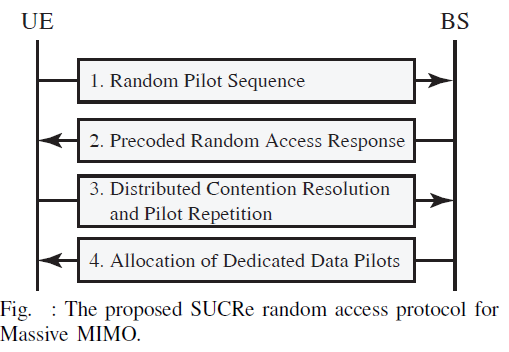
In this paper, we revisit the random access problem in the Massive MIMO context and develop a re engineered protocol, termed strongest-user collision resolution (SUCRe). The Massive MIMO (multiple-input multiple output) technology has a great potential to manage the rapid growth of wireless data traffic. Massive MIMO achieves tremendous spectral efficiency by spatial multiplexing of many tens of User Equipment's (UE's). These gains are only achieved in practice if many more UE's can connect efficiently to the network than today.
As the number of UE's increases, while each UE intermittently accesses the network, the random access functionality becomes essential to share the limited number of pilots among the UE's. An accessing UE asks for a dedicated pilot by sending an uncoordinated random access pilot, with a risk that other UE's send the same pilot. The favorable propagation of Massive MIMO channels is utilized to enable distributed collision detection at each UE, thereby determining the strength of the contenders’ signals and deciding to repeat the pilot if the UE judges that its signal at the receiver is the strongest. The SUCRe protocol resolves the vast majority of all pilot collisions in crowded urban scenarios and continues to admit UE's efficiently in overloaded networks.
NOTE: Without the concern of our team, please don't submit to the college. This Abstract varies based on student requirements.
Block Diagram
Specifications
Software: Matlab 2018a or above
Hardware:
Operating Systems:
- Windows 10
- Windows 7 Service Pack 1
- Windows Server 2019
- Windows Server 2016
Processors:
Minimum: Any Intel or AMD x86-64 processor
Recommended: Any Intel or AMD x86-64 processor with four logical cores and AVX2 instruction set support
Disk:
Minimum: 2.9 GB of HDD space for MATLAB only, 5-8 GB for a typical installation
Recommended: An SSD is recommended A full installation of all Math Works products may take up to 29 GB of disk space
RAM:
Minimum: 4 GB
Recommended: 8 GB

Contact Us
- info@takeoffprojects.com
- +91 9030333433, +91 9393939065


 Paper Publishing

Request Call Back
Would you like to receive a free callback now?
Choose the best time for callback:
Leave your message and we will contact you as soon as possible

6-2-85/B, Old Maternity Hospital Road, Thyagaraja Nagar, Tirupati, Andhra Pradesh – 517501
+91 9030333433
+91 9393939065
0877-2261612

Disclaimer - Takeoff Edu Group Projects are not associated or affiliated with IEEE in any way. The IEEE Projects mentioned here are mentioned in the context of student projects, whose ideas are derived from IEEE publications, not projects of or by IEEE.

