A Power Quality Improved Ev Charger With Bridgeless Cuk Converter
Also Available Domains Power Quality
Abstract
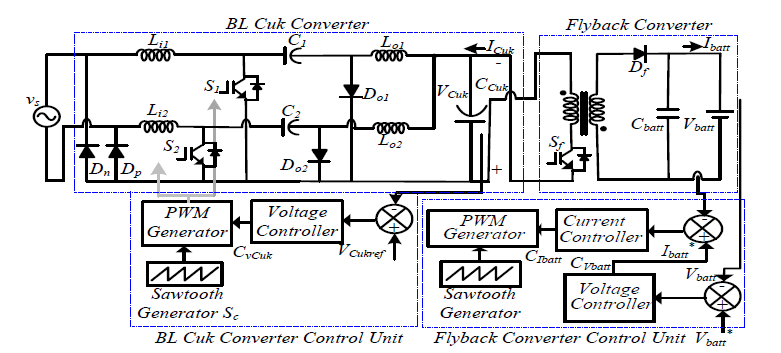
An improved bridgeless (BL) Cuk converter based EV (Electric Vehicle) battery charger with high power factor (PF) and increased efficiency, is designed and developed in this work. It provides low cost and high power density based charging solution for EV. This charger incorporates less number of devices operating over one switching cycle, which reduces the additional conduction loss incurred by a diode bridge rectifier of conventional charger. Hence, it improves the charger efficiency. The added advantage of proposed topology is that the unwanted capacitive coupling loop is removed, as well as unwanted conduction through the body diode of inactive switch in previously developed BL Cuk converter is avoided. This significantly improves the charger efficiency. For the constant current (CC) and constant voltage (CV) charging, the commands, are synchronized by a flyback converter. The proposed charger draws a sinusoidal current from AC mains along with the total harmonic distortion (THD) in supply current is reduced to the limits specified by the IEC 61000-3-2 guidelines. The improved efficiency and PQ indices of proposed charger, are investigated to demonstrate its satisfactory charging operation at all operating conditions.
NOTE: Without the concern of our team, please don't submit to the college. This Abstract varies based on student requirements.
Block Diagram
Specifications
Software Configuration:
Operating System : Windows 7/8/10
Application Software : Matlab/Simulink
Hardware Configuration:
RAM : 8 GB / 4 GB (Min)
Processor : I3 / I5(Mostly prefer)
Learning Outcomes
- Introduction to Matlab/Simulink
- What is EISPACK & LINPACK
- How to start with MATLAB
- About Matlab language
- About tools & libraries
- Application of Matlab/Simulink
- About Matlab desktop
- Features of Matlab/Simulink
- Basics on Matlab/Simulink
- Introduction to controllers.
- Study of PWM techniques.
- Project Development Skills:
- Problem analyzing skills
- Problem solving skills
- Creativity and imaginary skills
- Programming skills
- Deployment
- Testing skills
- Debugging skills
- Project presentation skills
- Thesis writing skills


 Paper Publishing

Request Call Back
Would you like to receive a free callback now?
Choose the best time for callback:
Leave your message and we will contact you as soon as possible

6-2-85/B, Old Maternity Hospital Road, Thyagaraja Nagar, Tirupati, Andhra Pradesh – 517501
+91 9030333433
+91 9393939065
0877-2261612

Disclaimer - Takeoff Edu Group Projects are not associated or affiliated with IEEE in any way. The IEEE Projects mentioned here are mentioned in the context of student projects, whose ideas are derived from IEEE publications, not projects of or by IEEE.

