A Physics-Informed Neural Network and PEBDF Ensemble for EIS-Based Photovoltaic Degradation Detection
Objective
The main objective of this project is to develop an intelligent and reliable diagnostic system for classifying photovoltaic (PV) panel degradation using Electrochemical Impedance Spectroscopy (EIS) data. By combining a Physics-Informed Neural Network and a Penalty-Enhanced Bagging Decision Forest, the project aims to achieve highly accurate, physically consistent, and interpretable predictions. It also provides a user-friendly Flask-based web interface for real-time PV health assessment.
Abstract
This project develops an intelligent diagnostic system for photovoltaic (PV) panel degradation classification using Electrochemical Impedance Spectroscopy (EIS) data. A Physics-Informed Neural Network (PINN) is designed by integrating physical laws of Constant Phase Element (CPE) behavior directly into the training loss function. Additionally, a custom Penalty-Enhanced Bagging Decision Forest (PEBDF) is proposed with depth and impurity penalties to improve model generalization and interpretability. Both models are trained and evaluated on a synthetic EIS dataset containing four degradation classes: Healthy, Dusty, Microcracked, and Dusty+Microcracked. Feature importance analysis identifies the ten most significant EIS parameters, enabling efficient classification with minimal input. A web application is implemented using the Flask framework, providing user registration, secure login, and an intuitive interface for entering EIS parameters and receiving instant predictions with confidence scores and probability distribution. The system demonstrates high classification accuracy while maintaining physical consistency through the PINN model and strong generalization via the PEBDF ensemble. This work presents a novel hybrid approach combining physics-guided deep learning and constrained ensemble methods for accurate PV health monitoring.
Keywords: Photovoltaic degradation, Electrochemical Impedance Spectroscopy, Physics-Informed Neural Network, PINN, PEBDF, Flask, EIS classification, PV health monitoring, Constant Phase Element, Machine learning
NOTE: Without the concern of our team, please don't submit to the college. This Abstract varies based on student requirements.
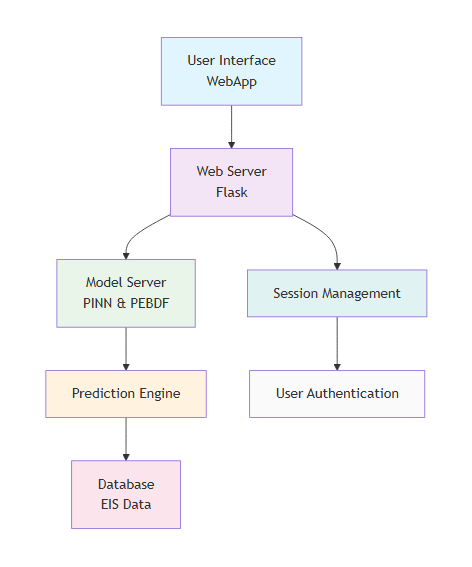
Block Diagram
Specifications
Hardware Requirements
Processor - I3/Intel Processor
Hard Disk - 160GB
Key Board - Standard Windows Keyboard
Mouse - Two or Three Button Mouse
Monitor - SVGA
RAM - 8GB
Software Requirements:
Operating System : Windows 7/8/10
Server side Script : HTML, CSS, Bootstrap & JS
Programming Language : Python
Libraries : Flask/Django, Pandas, Mysql.connector, Os, Smtplib, Numpy
IDE/Workbench : PyCharm
Technology : Python 3.6+
Server Deployment : Xampp Server
Database : MySQL

Demo Video


Request for Video
 Paper Publishing
Request Call Back
Would you like to receive a free callback now?
Choose the best time for callback:
Leave your message and we will contact you as soon as possible

6-2-85/B, Old Maternity Hospital Road, Thyagaraja Nagar, Tirupati, Andhra Pradesh – 517501
+91 9030333433
+91 9393939065
0877-2261612

Disclaimer - Takeoff Edu Group Projects are not associated or affiliated with IEEE in any way. The IEEE Projects mentioned here are mentioned in the context of student projects, whose ideas are derived from IEEE publications, not projects of or by IEEE.

