A Pairing Free Provable Public Key Dual Receiver Encryption Scheme
Objective
The Dual Receiver Encryption (DRE) scheme improves efficiency and verifiability by using the decisional Diffie-Hellman assumption instead of bilinear pairings, offering strong security and reduced complexity against chosen ciphertext attacks.
Abstract
Preserving the privacy of sensitive data such as mercantile, medical, political or financial might utilize encryption, these encrypted data, in some cases, may be needed to be decrypted by other party, for this issue, the dual receiver encryption, DRE, scheme is constructed. Since the development of the first DRE and until now, several DRE schemes have been constructed, some of these schemes are based on bilinear pairings and others are lattice based. The lattice based DRE schemes have larger key size and does not corroborate the public verifiability whereas pairing based schemes suffers from higher computational cost. In the present work, we propose a construction of DRE without pairing to avoid the computational complexity problems. The proposed scheme is based on the decisional Diffie-Hellman security assumption. Our proposed scheme is secure under chosen cipher text attack. In addition, the suggested scheme achieves public verifiability and reduces computational complexity. In terms of computational complexity, our scheme saves about 53% compared to others with pairing in literature.
KEYWORDS: Security, security systems, dual receiver encryption, discrete logarithm problem, Diffie Hellman assumption, bilinear pairing based cryptography, lattice- based cryptography, CCA security, Internet of Things (IoT).
NOTE: Without the concern of our team, please don't submit to the college. This Abstract varies based on student requirements.
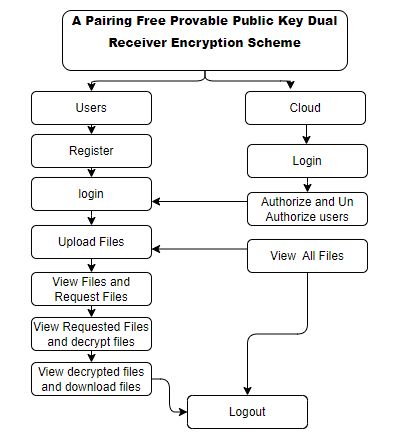
Block Diagram
Specifications
H/W CONFIGURATION:
Processor - I3/Intel Processor
Hard Disk - 160GB
Key Board - Standard Windows Keyboard
Mouse - Two or Three Button Mouse
Monitor - SVGA
RAM - 8GB
S/W CONFIGURATION:
• Operating System : Windows 7/8/10
• Server side Script : HTML, CSS, Bootstrap & JS
• Programming Language : Python
• Libraries : Django, Pandas, MySQL. Connector, Os, Smtplib, Numpy
• IDE/Workbench : PyCharm
• Technology : Python 3.6+

Demo Video


Request for Video
 Paper Publishing
Request Call Back
Would you like to receive a free callback now?
Choose the best time for callback:
Leave your message and we will contact you as soon as possible

6-2-85/B, Old Maternity Hospital Road, Thyagaraja Nagar, Tirupati, Andhra Pradesh – 517501
+91 9030333433
+91 9393939065
0877-2261612

Disclaimer - Takeoff Edu Group Projects are not associated or affiliated with IEEE in any way. The IEEE Projects mentioned here are mentioned in the context of student projects, whose ideas are derived from IEEE publications, not projects of or by IEEE.

