A novel phase-locked loop for mitigating the subsequent commutation failures of LCC-HVDC systems
Objective
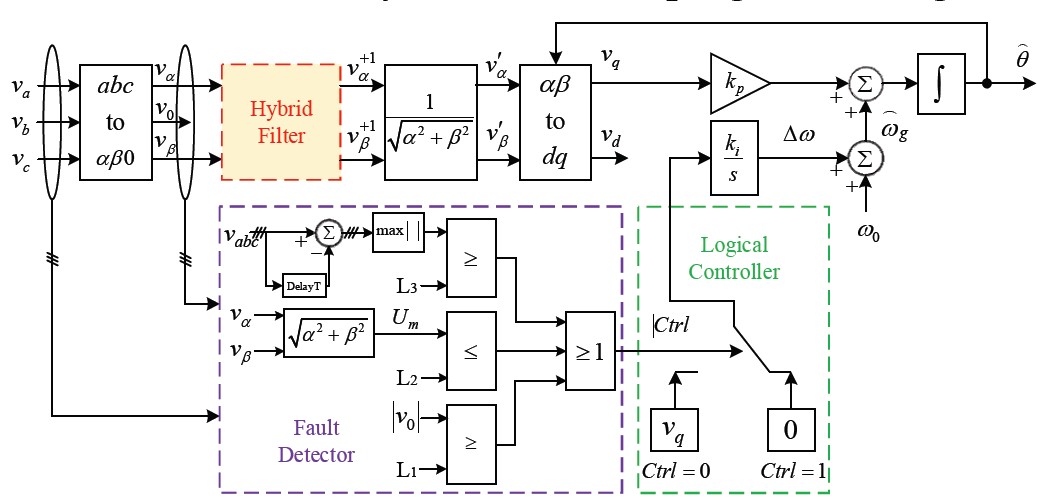
Main objective of this project is to reduce the fluctuation of PLL’s frequency during AC faults. And the estimated frequency is fixed when the fault is detected by a fault detector
Abstract
In this project, AC fault ride-through and support capability of Line Commutated Converter Based High Voltage Direct Current (LCC-HVDC) is proposed which have significant influence on the safe operation of power system. The ability of Phase Locked Loop (PLL) to synchronize with the voltage phase under AC faults would affect the recovery performance of LCC-HVDC systems.
This project analyzes the influence of the conventional PLL on the Subsequent Commutation Failure (SCF) of LCC-HVDC systems and points out that the conventional PLL has some problems such as slow dynamic response, significant frequency fluctuation, and coupling of phase and frequency detection under fault conditions. A novel PLL is proposed to address the problems. Cascade delayed signal cancellation operators are combined with a mathematical filter, forming a hybrid pre-filter to extract fundamental positive sequence voltage for the PLL.
To reduce the fluctuation of PLL’s frequency during AC faults, the estimated frequency is fixed when the fault is detected by a fault detector. As a consequence, the decoupling between phase detection and frequency detection is realized, and the proposed PLL’s dynamic response performance is enhanced. Simulation results show that the proposed PLL can provide accurate phase reference for the DC control system and reduce the probability of SCFs of LCC-HVDC system.
Keywords: Line Commutated Converter Based High Voltage Direct Current (LCC-HVDC), Phase Locked Loop (PLL), Subsequent Commutation Failure (SCF).
NOTE: Without the concern of our team, please don't submit to the college. This Abstract varies based on student requirements.
Block Diagram
Specifications
Software Configuration:
Operating System : Windows 7/8/10
Application Software : Matlab/Simulink
Hardware Configuration:
RAM : 8 GB / 4 GB (Min)
Processor : I3 / I5(Mostly prefer)
Learning Outcomes
- Introduction to Matlab/Simulink
- What is EISPACK & LINPACK
- How to start with MATLAB
- About Matlab language
- About tools & libraries
- Application of Matlab/Simulink
- About Matlab desktop
- Features of Matlab/Simulink
- Basics on Matlab/Simulink
- Introduction to Matlab
- Types of transformation
- Types of PWM
- Introduction to converters
- Introduction to PLL
- Introduction to types of filters
- Introduction to micro grid
- Introduction to PI controllers
- Introduction to IGBT
- Introduction to steady state and dynamic state
- Introduction to subsequent commutation failure
- Introduction to LCC-HVDC
- Introduction to SRF-PLL
- Introduction to HVDC
- Introduction to voltage controlled oscillator
- Introduction to hybrid filters
- Introduction to CDSC
- Introduction to DSOGI-PLL
- Introduction to GDSC-PLL
- Introduction to CIGRE HVDC benchmark model
- Project Development Skills:
- Problem analyzing skills
- Problem solving skills
- Creativity and imaginary skills
- Programming skills
- Deployment
- Testing skills
- Debugging skills
- Project presentation skills
- Thesis writing skills
Demo Video


Request for Video
 Paper Publishing
Request Call Back
Would you like to receive a free callback now?
Choose the best time for callback:
Leave your message and we will contact you as soon as possible

6-2-85/B, Old Maternity Hospital Road, Thyagaraja Nagar, Tirupati, Andhra Pradesh – 517501
+91 9030333433
+91 9393939065
0877-2261612

Disclaimer - Takeoff Edu Group Projects are not associated or affiliated with IEEE in any way. The IEEE Projects mentioned here are mentioned in the context of student projects, whose ideas are derived from IEEE publications, not projects of or by IEEE.

