A Novel Low Power, Low Area Array Multiplier Design for DSP Applications
Objective
The objective of "A Novel Low Power, Low Area Array Multiplier Design for DSP Applications" is likely focused on developing a new, innovative array multiplier that consumes less power and occupies a smaller physical space, specifically tailored for use in Digital Signal Processing (DSP) applications. This design aims to enhance the efficiency and performance of DSP systems by providing a more energy-efficient and compact solution for multiplication operations, which are fundamental in digital signal processing algorithms.
Abstract
This paper presents a novel low power and low area array multiplier utilizing a carry save adder. Unlike conventional parallel array multipliers, the proposed design eliminates the final addition stage. Both conventional and proposed multipliers are synthesized using 16-T full adders. Among various adder types evaluated—Transmission Gate, Transmission Function, and 14-T and 16-T full adders—the 16-T full adder demonstrates superior energy efficiency.
In the proposed 4x4 multiplier architecture, carry bits are added without employing a Ripple Carry Adder (RCA) in the final stage. Instead, carries are fed into the input of the next left column, effectively optimizing transistor count. This results in a reduction of 56 transistors, albeit with a trade-off between power and area.
For a 90nm technology at a supply voltage of 1.2V, the proposed multiplier exhibits compelling performance metrics compared to the conventional approach. Specifically, it achieves a reduction in power consumption, increase in speed, and a significant decrease in energy consumption. These findings underscore the efficiency gains and benefits of the proposed design for DSP applications demanding low power and area-efficient solutions.
NOTE: Without the concern of our team, please don't submit to the college. This Abstract varies based on student requirements.
Block Diagram
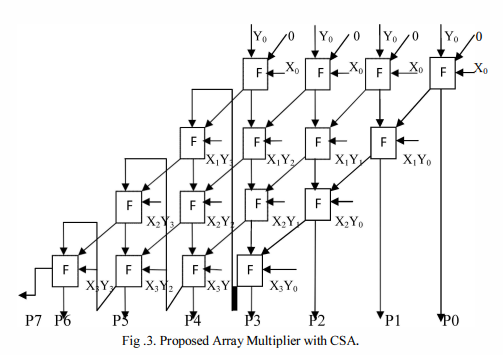
Specifications
Software Requirements:
· Tool: Tanner EDA
· Technology :90nm
Minimum Hardware Requirements:
· Microsoft Windows 7
· Intel i3 processor or equivalent
· 5GB RAM
· 100MB of available disk space
Learning Outcomes
· Basics of electronics
· VLSI design flow
· Introduction to adders
· Knowledge on transistor level implementation
· Introduction to combinational circuits
· Understanding of DSP Requirements and Constraints
· Knowledge of Multiplier Architectures
· Knowledge on Carry select adder
· Low Power Design Techniques
· Multiplier Applications in real time
· Tanner tool implementation, schematic, simulation
· Solution providing for real time problems
· Project Development Skills:
o Problem Analysis Skills
o Problem Solving Skills
o Designing Skills
o Testing Skills
o Debugging Skills
o Presentation Skills
o Thesis Writing Skills


 Paper Publishing

Request Call Back
Would you like to receive a free callback now?
Choose the best time for callback:
Leave your message and we will contact you as soon as possible

6-2-85/B, Old Maternity Hospital Road, Thyagaraja Nagar, Tirupati, Andhra Pradesh – 517501
+91 9030333433
+91 9393939065
0877-2261612

Disclaimer - Takeoff Edu Group Projects are not associated or affiliated with IEEE in any way. The IEEE Projects mentioned here are mentioned in the context of student projects, whose ideas are derived from IEEE publications, not projects of or by IEEE.

