A Novel ECG Signal Quality Index Method Based on Skewness-MODWT Analysis and Detection of Arrhythmia with BPM
Objective
To develop an efficient ECG monitoring system, this study proposes a new Signal Quality Index (SQI) method for accurate signal classification and analysis.
Abstract
Because of their ease of use and compact size, wearable devices have become increasingly popular for continuous electrocardiogram (ECG) monitoring. It is necessary to do continuous, day-to-day, round-the-clock monitoring in order to identify anomalous symptoms that may be early warning indicators of serious illnesses. To keep the system running and increase the amount of time that devices can be used, cost-saving measures must come first. Nevertheless, not all recorded data are valuable due to many factors influencing the signal quality, including noise from muscles and motion aberrations. It is necessary to categorize and transmit just the useful signals in order to preserve wearable device batteries and server-side (cloud-based) processing costs related to processing and storage resources.
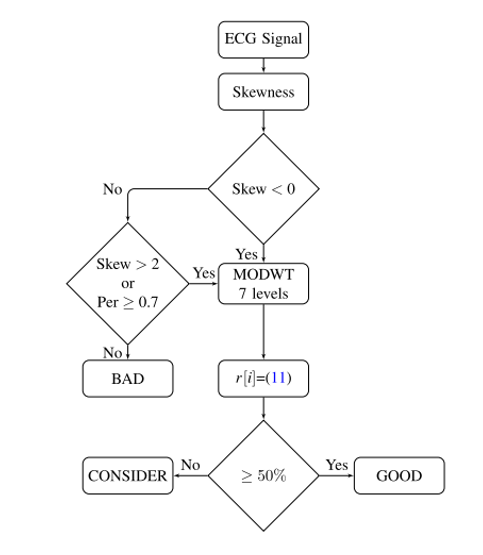
In order to assess signal quality and satisfy the aforementioned criteria, Signal Quality Indices (SQIs) have been created and studied. This paper presents a new SQI method for signal classification. Three things are added by the suggested method: Three methods are used to classify ECG signals: 1) use the lightweight exponentially weighted mean-variance (EWMV) equation to identify peaks; 2) define peaks that have the same shape as R-peaks by applying an adaptive threshold; and 3) use the maximal overlap discrete wavelet transform (MODWT) to classify signals into a new class that may contain signals relevant to pathological analysis. Our approach achieves the best sensitivity for both noisy and noiseless data sets, as shown by experimental findings. And finally with the use of extracted peaks in the previous stage, we can calculate Beats Per Minute (BPM) to determine the final health condition of heart i.e., Arrhythmia.
Keywords: Electrocardiogram (ECG), exponentially weighted mean-variance (EWMV), maximal overlap discrete wavelet transform (MODWT), signal quality indices (SQIs), BPM.
NOTE: Without the concern of our team, please don't submit to the college. This Abstract varies based on student requirements.
Block Diagram
Specifications
Software: Matlab 2020a or above
Hardware:
Operating Systems:
- Windows 10
- Windows 7 Service Pack 1
- Windows Server 2019
- Windows Server 2016
Processors:
Minimum: Any Intel or AMD x86-64 processor
Recommended: Any Intel or AMD x86-64 processor with four logical cores and AVX2 instruction set support
Disk:
Minimum: 2.9 GB of HDD space for MATLAB only, 5-8 GB for a typical installation
Recommended: An SSD is recommended A full installation of all MathWorks products may take up to 29 GB of disk space
RAM:
Minimum: 4 GB
Recommended: 8 GB
Learning Outcomes
· Introduction to Matlab
· What is EISPACK & LINPACK
· How to start with MATLAB
· About Matlab language
· Matlab coding skills
· About tools & libraries
· Application Program Interface in Matlab
· About Matlab desktop
· How to use Matlab editor to create M-Files
· Features of Matlab
· Basics on Matlab
· What is Signal Processing?
· About Signal Processing
· Introduction to Signal Processing
· How analog and digital signal is formed
· Importing the signal via signal acquisition tools
· Analyzing and manipulation of signals.
· Phases of signal processing:
· Acquisition
· Signal enhancement
· Signal restoration
· Medical Signal Processing
· Medical Signal Analysis
· Medical Signal Diagnosis
· Filtering techniques
· Machine Learning Algorithms
· Deep Learning Algorithms etc.
· How to extend our work to another real time applications
· Project development Skills
o Problem analyzing skills
o Problem solving skills
o Creativity and imaginary skills
o Programming skills
o Deployment
o Testing skills
o Debugging skills
o Project presentation skills
o Thesis writing skills


 Paper Publishing

Request Call Back
Would you like to receive a free callback now?
Choose the best time for callback:
Leave your message and we will contact you as soon as possible

6-2-85/B, Old Maternity Hospital Road, Thyagaraja Nagar, Tirupati, Andhra Pradesh – 517501
+91 9030333433
+91 9393939065
0877-2261612

Disclaimer - Takeoff Edu Group Projects are not associated or affiliated with IEEE in any way. The IEEE Projects mentioned here are mentioned in the context of student projects, whose ideas are derived from IEEE publications, not projects of or by IEEE.

