A Novel Design for Circular patch Fractal Antenna for Multiband Applications
Objective
To design and analyze a compact fractal-based circular patch antenna capable of multiband operation, achieving improved performance in terms of return loss, bandwidth, directivity, and VSWR using HFSS simulation.
Abstract
Abstract:
Remote Communication Technology is the greatest disclosure in the historical backdrop of humankind in the territories of complex advanced correspondence systems. Information between at least one gadgets ta the need of any physical media. Such framework on its receiving wire framework for effective transmission of data as radio waves. W cutting edge innovation frameworks like cell satellite, and rocket applications, low p required for its little size, less weight, execution and simplicity of establishment.
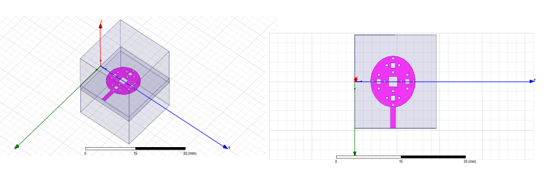
In this proposed work, a novel outline fractal receiving wire plan for a roundabout fix antenna. This roundabout fix reception apparatus is utilized for works at six unique frequencies at 10.3GHz, 16.7GHZ, 21.7GHz, 25.1GHz, 43.3GHzand49.3GHz. Fractal design system is utilized in light of its self-comparable and space filling property. The region of the proposed radio wire is to be decreased by utilizing the roundabout fix antenna. The dielectric of substrate is 2.2 that is Rogers RT Duroid5880 substrate of measurement. The radiation design, directivity, return misfortune, VSWR and Bandwidth of the proposed radio wire are figured by utilizing the HFSS.13 programming bundle.
NOTE: Without the concern of our team, please don't submit to the college. This Abstract varies based on student requirements.
Block Diagram
Specifications
Software & Hardware Requirements:
´ Software: SYSTEM REQUIREMENTS
´ SOFTWARE REQUIREMENTS:
´ OS: Windows
´ Software: HFSS software
´ HARDWARE REQUIREMENTS:
´ Processor: Intel Pentium.
´ RAM: 2GB
´ SOFTWARE DESCRIPTION:
´ Hardware Requirement & Software Requirement
´ Microsoft Windows XP (32/64), Windows 2000, or Windows 2003 Server. For up to-date information, refer to the HFSS Release Notes.
´ Pentium –based computer
´ 128MB RAM minimum
´ 8MB Video Card minimum
´ Mouse or another pointing device
Learning Outcomes
- Introduction to HFSS
- What is Antenna designing
- How to start with HFSS antenna designing.
- About Electromagnetic environmental setup
- Designing skills
- About libraries
- How to add feed, radiation patterns for Antenna.
- About HFSS desktop
- How to use different shapes in creation of Antenna
- Features of HFSS
- Basics on HFSS
- How to create EM fields in HFSS.
- How to generate directive gain, return loss graphs for different frequencies.
- How to extend our work to another real time applications
- Project development Skills
- Problem analyzing skills
- Problem solving skills
- Creativity and imaginary skills
- Programming skills
- Deployment
- Testing skills
- Debugging skills
- Project presentation skills
- Thesis writing skills
Software: HFSS Antenna designing.
Hardware:
- 64-bit Intel or AMD system, running Windows 10.
- 8 GB RAM
- A dedicated graphics card with latest drivers and at least 1GB video RAM, capable of supporting OpenGL 4.5 and DirectX 11, or higher. Use of integrated graphics (e.g., Intel HD/IRIS) is not recommended and is not support by the Analyze stage in Discovery. See below for special graphics requirements for ANSYS Discovery Live.
- 3 button Mouse.


 Paper Publishing

Request Call Back
Would you like to receive a free callback now?
Choose the best time for callback:
Leave your message and we will contact you as soon as possible

6-2-85/B, Old Maternity Hospital Road, Thyagaraja Nagar, Tirupati, Andhra Pradesh – 517501
+91 9030333433
+91 9393939065
0877-2261612

Disclaimer - Takeoff Edu Group Projects are not associated or affiliated with IEEE in any way. The IEEE Projects mentioned here are mentioned in the context of student projects, whose ideas are derived from IEEE publications, not projects of or by IEEE.

