A Novel Decentralized Control Algorithm for Hybrid Energy Storage System in Islanded DC Smart Grid
Objective
The main objective of the project is to develop a new control technique for hybrid energy storage system in an islanded DC smart grid, integrating batteries and super capacitors to enhance reliability and efficiency.
Abstract
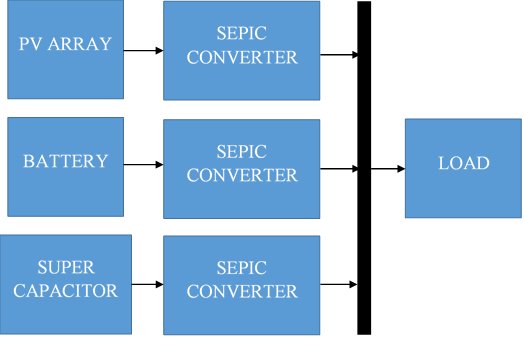
This paper proposes a new hybrid energy storage grid-connected photovoltaic (PV) system in an island DC smart grid, where maximum power point tracking (MPPT) is the power factor. Incorporated into DC/DC converter. Less power consumption and less energy loss during transmission. Typically, in smart grids, hybrid energy storage systems (HESS) consisting of batteries and large capacitors are used to increase the reliability of smart grids and replace super-capacitors with battery life. Maintaining the condition of batteries and super-capacitors under acceptable conditions is an important step in resolving the uncertainties in renewable energy. Thus, this energy management plays an especially role in the continuous operation and reliability of smart grids. In this study, a smart DC grid consist of batteries, photovoltaic cells, and super-capacitors and the proposed control system are designed and compared. The main suggested of the control system is to control the operation of the super-capacitor and its correct operation during load switching. In the super-capacitor control system, a two-stage voltage and current controller and a loop impedance circuit are used to make the super-capacitor current in a neutral state and produce step changes. The main of the suggested control system is to expand the power of the HESS, especially the storage controller, when changing the steps and voltages of the DC smart grid island. The design also handles MPPT and does not use power electronics, extending the life of the PV system design in a robust and cost-effective manner. Finally, in order to verify the accuracy of the experimental results on MATLAB/Simulink software, ISE and its functions were evaluated in several cases and the results were analysed.
Keywords: battery, DC smart grid, Inverse of SEPIC, super-capacitor, PI controller, MPPT – P&O algorithm.NOTE: Without the concern of our team, please don't submit to the college. This Abstract varies based on student requirements.
Block Diagram
Specifications
Software Configuration:
Operating System : Windows 7/8/10
Application Software: Matlab/Simulink
Hardware Configuration:
RAM : 8 GB
Processor : I3 / I5 (Mostly prefer)Learning Outcomes
· Introduction to Matlab/Simulink
· What is EISPACK & LINPACK
· How to start with MATLAB
· About Matlab language
· About tools & libraries
· Application of Matlab/Simulink
· About Matlab desktop
· Features of Matlab/Simulink
· Basics on Matlab/Simulink
· We can learn about Solar PV Systems
· We can learn about MPPT technique
· We can learn about P&O algorithm
· We can learn about SEPIC converter
· We can learn about battery & super-capacitor
· Project Development Skills:
o Problem analyzing skills
o Problem solving skills
o Creativity and imaginary skills
o Programming skills
o Deployment
o Testing skills
o Debugging skills
Project presentation skillsDemo Video


Request for Video
 Paper Publishing
Request Call Back
Would you like to receive a free callback now?
Choose the best time for callback:
Leave your message and we will contact you as soon as possible

6-2-85/B, Old Maternity Hospital Road, Thyagaraja Nagar, Tirupati, Andhra Pradesh – 517501
+91 9030333433
+91 9393939065
0877-2261612

Disclaimer - Takeoff Edu Group Projects are not associated or affiliated with IEEE in any way. The IEEE Projects mentioned here are mentioned in the context of student projects, whose ideas are derived from IEEE publications, not projects of or by IEEE.

