A Novel Asymmetrical 21-Level Inverter for Solar PV Energy System With Reduced Switch Count
Objective
The main objective of this project is to presents a novel asymmetrical 21-level multilevel inverter topology for solar PV application.
Abstract
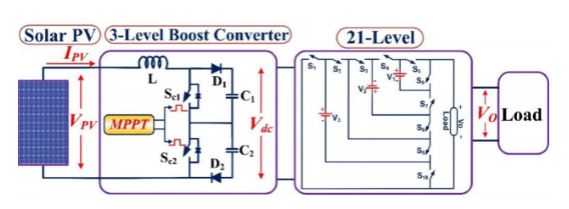
This article presents a novel asymmetrical 21-level multilevel inverter topology for solar PV application. The proposed topology achieves 21-level output voltage without H-bridge using asymmetric DC sources. This reduces the devices, cost and size. The PV standalone system needs a constant DC voltage magnitude from the solar panels, Maximum Power Point Tracking (MPPT) technique used for getting a stable output by using Perturb And Observe (P&O) algorithm.
The PV voltage is boosted over the DC link voltage using a three-level DC-DC boost converter interfaced in between the solar panels and the inverter. The inverter is tested experimentally with various combinational loads and under dynamic load variations with sudden load disturbances. Total standing voltage with a cost function for the proposed MLI is calculated and compared with multiple topologies published recently and found to be cost-effective.
A detailed comparison is made in terms of switches count, and sources count, gate driver boards, the number of diodes and capacitor count and component count level factor with the same and other levels of multilevel inverter and found to be the proposed topology is helpful in terms of its less TSV value, devices count, efficient and costeffective. In both simulation and experimental results, total harmonic distortion (THD) is observed to be the same and is lower than 5% which is under IEEE standards. A hardware prototype is implemented in the laboratory and verified experimentally under dynamic load variations, whereas the simulations are done in MATLAB/Simulink.
INDEX TERMS Multilevel inverter, photovoltaic (PV) system, maximum power point tracking (MPPT), total harmonic distortion (THD).
NOTE: Without the concern of our team, please don't submit to the college. This Abstract varies based on student requirements.
Block Diagram
Specifications
Software Configuration:
Operating System : Windows 7/8/10
Application Software : Matlab/Simulink
Hardware Configuration:
RAM : 8 GB
Processor : I3 / I5(Mostly prefer)
Learning Outcomes
- Introduction to Matlab/Simulink
- What is EISPACK & LINPACK
- How to start with MATLAB
- About Matlab language
- About tools & libraries
- Application of Matlab/Simulink
- About Matlab desktop
- Features of Matlab/Simulink
- Basics on Matlab/Simulink
- Introduction to solar power generation
- Introduction to Matlab/Simulink software
- Introduction to power electronics converters
- Introduction to boost converters
- Design of 3-level boost converter
- Design of multi level inverter
- Design of pv panel
- We can learn about the generation of gate pulses to the converter
- Project Development Skills:
- Problem analyzing skills
- Problem solving skills
- Creativity and imaginary skills
- Programming skills
- Deployment
- Testing skills
- Debugging skills
- Project presentation skills
- Thesis writing skills
Demo Video


Request for Video
 Paper Publishing
Request Call Back
Would you like to receive a free callback now?
Choose the best time for callback:
Leave your message and we will contact you as soon as possible

6-2-85/B, Old Maternity Hospital Road, Thyagaraja Nagar, Tirupati, Andhra Pradesh – 517501
+91 9030333433
+91 9393939065
0877-2261612

Disclaimer - Takeoff Edu Group Projects are not associated or affiliated with IEEE in any way. The IEEE Projects mentioned here are mentioned in the context of student projects, whose ideas are derived from IEEE publications, not projects of or by IEEE.

