A Novel 18T Hybrid Master-Slave Flip-Flop With Low Power and Delay
Objective
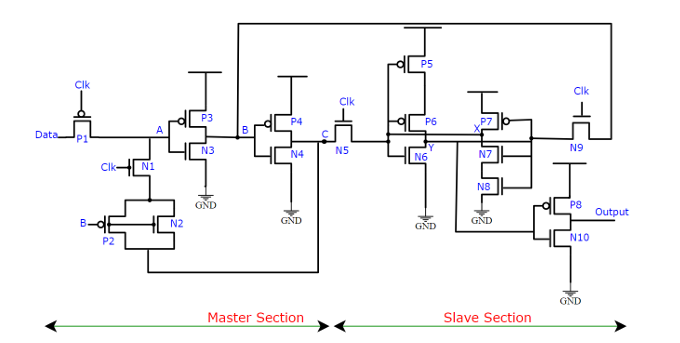
This paper presents a novel 18-transistor hybrid master-slave flip-flop called the Proposed Flip-Flop Circuit (PFC), designed using 45nm CMOS technology with a single-phase clock. The circuit is divided into two sections — the master section, which uses a level restoring circuit to retain data, and the slave section, which employs a transistor stacking technique to minimize leakage current. The PFC is primarily optimized for three key performance metrics: power consumption, propagation delay, and chip area
Abstract
This paper presents a novel 18-transistor hybrid master-slave flip-flop called the Proposed Flip-Flop Circuit (PFC), designed using 45nm CMOS technology with a single-phase clock. The circuit is divided into two sections — the master section, which uses a level restoring circuit to retain data, and the slave section, which employs a transistor stacking technique to minimize leakage current. The PFC is primarily optimized for three key performance metrics: power consumption, propagation delay, and chip area. In terms of average power consumption, PFC outperforms existing designs such as ADTFF, HFF, 18TSPC, LSRFF, TCFF, and CSFF by margins ranging from 26.02% to 50.68%. It also achieves significant speed improvements by reducing the clock-to-Q delay by 23.32% to 38.79% compared to those same designs. Monte Carlo simulations conducted over 1000 samples validated the PFC's average power consumption and C-to-Q delay performance, confirming its robustness across manufacturing variations. By reducing the PMOS transistor count and using only 4 clock signals (compared to 5 or more in existing designs), the PFC achieves a smaller layout area and lower clock power overhead, making it well-suited for high-speed, energy-efficient applications such as smartphones, laptops, and portable electronics operating at up to 1 GHz.
KEYWORDS: Master-slave flip-flop, low power, Monte Carlo simulations, clock overloading, CMOS, switching activity, leakage powerNOTE: Without the concern of our team, please don't submit to the college. This Abstract varies based on student requirements.
Block Diagram
Specifications
Learning Outcomes
· Understanding of CMOS Technology and 45nm Technology Node
· Knowledge of Master-Slave Flip-Flop Design and Operation
· Understanding of Pass-Transistor Logic Concepts
· Knowledge of Level Restoring Circuit Techniques
· Understanding of Transistor Stacking Technique for Leakage Reduction
· Ability to Analyze Power Consumption in Digital Circuits
· Understanding of Clock-to-Q and Data-to-Q Delay Analysis
· Knowledge of Setup Time and Hold Time Calculations


 Paper Publishing

Request Call Back
Would you like to receive a free callback now?
Choose the best time for callback:
Leave your message and we will contact you as soon as possible

6-2-85/B, Old Maternity Hospital Road, Thyagaraja Nagar, Tirupati, Andhra Pradesh – 517501
+91 9030333433
+91 9393939065
0877-2261612

Disclaimer - Takeoff Edu Group Projects are not associated or affiliated with IEEE in any way. The IEEE Projects mentioned here are mentioned in the context of student projects, whose ideas are derived from IEEE publications, not projects of or by IEEE.

