A New Protection Scheme for an SSSC in an MV Network by Using a Varistor and Thyristors
Objective
Main objective of this project is to protect the SSSC in an MV network and improve the reliability and flexibility of the network operation.
Abstract
In this project to control power flow and manage fault level in meshed MV networks, Back-To-Back Voltage Source Converters (B2B-VSCs) are being used. However, their high cost and relatively low efficiency are of concerns. Partially rated series compensators, such as SSSCs or UPFCs, are desired but come with the challenge of protecting the device during grid faults. Their potential of use has been limited in comparison with the fully rated Back-To-Back Converters.
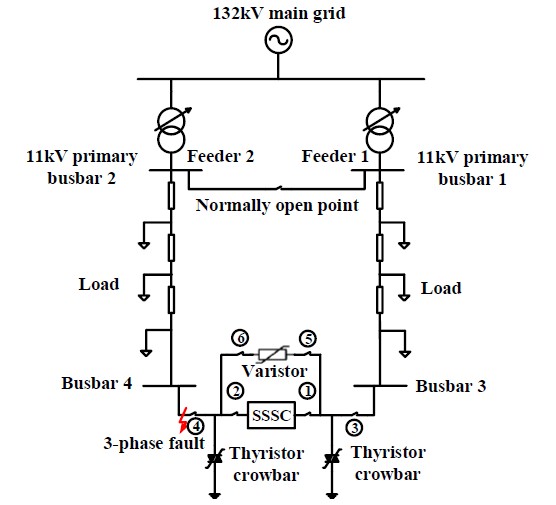
This paper proposes a new system topology including thyristor crowbars and a Varistor to protect the SSSC in an MV network and improve the reliability and flexibility of the network operation. Using the proposed method, the time required for isolating the series compensator from the grid is reduced from at least 20 ms, corresponding to the interruption time of conventional circuit breakers, down to 3 μs in the worst case in addition to the grid fault detection delay. The performance is evaluated by simulation.
Keywords: Power system reliability, power system fault, protection, static synchronous series compensator, power semiconductors, thyristor, Varistor.
NOTE: Without the concern of our team, please don't submit to the college. This Abstract varies based on student requirements.
Block Diagram
Specifications
Software Configuration:
Operating System : Windows 7/8/10
Application Software : Matlab/Simulink
Hardware Configuration:
RAM : 8 GB / 4 GB (Min)
Processor : I3 / I5(Mostly prefer)
Learning Outcomes
- Introduction to Matlab/Simulink
- What is EISPACK & LINPACK
- How to start with MATLAB
- About Matlab language
- About tools & libraries
- Application of Matlab/Simulink
- About Matlab desktop
- Features of Matlab/Simulink
- Basics on Matlab/Simulink
- Types of transformation
- Types of PWM
- Introduction to converters
- Introduction to PLL
- Introduction to types of filters
- Introduction to micro grid
- Introduction to PI controllers
- Introduction to IGBT
- Introduction to steady state and dynamic state
- Introduction to active power filters
- Introduction to finite impulse response
- Introduction to Total harmonic distortion
- Introduction to model predictive controller
- Introduction types of loads
- Introduction to facts
- Introduction to Statcom
- Introduction to ideal control
- Introduction to delayed control
- Introduction to optimum prediction.
- Project Development Skills:
- Problem analyzing skills
- Problem solving skills
- Creativity and imaginary skills
- Programming skills
- Deployment
- Testing skills
- Debugging skills
- Project presentation skills
- Thesis writing skills
Demo Video


Request for Video
 Paper Publishing
Request Call Back
Would you like to receive a free callback now?
Choose the best time for callback:
Leave your message and we will contact you as soon as possible

6-2-85/B, Old Maternity Hospital Road, Thyagaraja Nagar, Tirupati, Andhra Pradesh – 517501
+91 9030333433
+91 9393939065
0877-2261612

Disclaimer - Takeoff Edu Group Projects are not associated or affiliated with IEEE in any way. The IEEE Projects mentioned here are mentioned in the context of student projects, whose ideas are derived from IEEE publications, not projects of or by IEEE.

