A New Energy-Efficient and High Throughput Two-Phase Multi-Bit per Cycle Ring Oscillator-Based True Random Number Generator
Also Available Domains Transistor Logic|Tanner EDA|Cadence EDA
Objective
The main objective of this work is to achieve the high throughput of Random number generation and make the system to be energy efficient. The proposed circuit is designed in a standard 45 nm 1.2 V CMOS process to perform the True random number generation.
Abstract
Generator
Abstract:
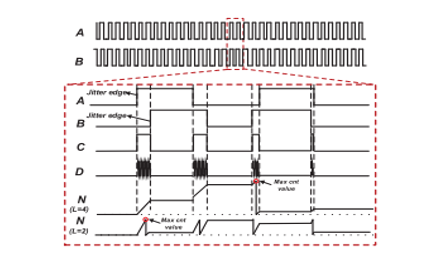
Oscillator-based elementary true random number generator (TRNG) design is proposed to minimize the power wasted by the superfluous oscillations. Random bits are extracted from both phases of the slow ROs to increase the throughput and the fast RO is activated only during the narrow transition time difference between two symmetrically designed slow ROs. The slow jittery ROs are implemented using current starved inverters biased in the weak inversion region to reduce their power consumption. Their jitter amplitudes are increased by lowering the Oscillation frequency and reducing the drain current of the transistors. The narrow jittery pulse generated by the differential pair of slow ROs is quantized by the fastest three-stage RO. Two random bits from each phase of the jittery ROs can be extracted by using a gigahertz dynamic toggled D flip-flop counter to count the number of oscillatory cycles of the fast RO. The proposed TRNG is fabricated in a standard 45 nm 1.2 V CMOS process.
NOTE: Without the concern of our team, please don't submit to the college. This Abstract varies based on student requirements.
Block Diagram
Specifications
Software & Hardware Requirements
· Tanner EDA
· Technology files: 45nm
Hardware Requirements:
· Microsoft® Windows XP
· Intel® Pentium® 4 processor or Pentium 4 equivalent with SSE support
· 512 MB RAM
· 100 MB of available disk space
Learning Outcomes
Learning Outcomes:
- Introduction to current starved ring oscillators
- Types of current starved ring oscillators
- Limitations & Applications.
- Introduction to True random number generator.
- Knowledge on jitter concept & current starved ring oscillators.
- Knowledge on Current Mirror circuits
- Importance of Transistors
- MOS Fundamentals
- NMOS/PMOS/CMOS Technologies
- How to design circuits using Transistor logic?
- Transistor level design for current starved ring oscillators.
- How to design Proposed circuits of current starved ring oscillators.
- Introduction to Analog Electronics
- Importance of TRNG
- Scope of TRNG in today’s world
- Applications in Real time.
- Tanner EDA tool for design and simulation
- Solution providing for real time problems
- Project Development Skills:
- Problem Analysis Skills
- Problem Solving Skills
- Logical Skills
- Designing Skills
- Testing Skills
- Debugging Skills
- Presentation skills
- Thesis Writing Skills


 Paper Publishing

Request Call Back
Would you like to receive a free callback now?
Choose the best time for callback:
Leave your message and we will contact you as soon as possible

6-2-85/B, Old Maternity Hospital Road, Thyagaraja Nagar, Tirupati, Andhra Pradesh – 517501
+91 9030333433
+91 9393939065
0877-2261612

Disclaimer - Takeoff Edu Group Projects are not associated or affiliated with IEEE in any way. The IEEE Projects mentioned here are mentioned in the context of student projects, whose ideas are derived from IEEE publications, not projects of or by IEEE.

