A MULTIMODAL DEEP LEARNING MODEL INTEGRATING CNN AND TRANSFORMER FOR PREDICTING CHEMOTHERAPY INDUCED CARDIOTOXICITY
Objective
The main objective of this project is to design and implement a multimodal deep learning framework that can accurately predict chemotherapy-induced cardiotoxicity by analyzing Temporal Dynamic Imaging data. Specifically, the project aims to extract spatial features using Convolutional Neural Networks (CNN), model sequential dependencies using LSTM, GRU, and Transformer-based architectures, and evaluate the classification performance of various model combinations, including CNN + LSTM, CNN + GRU, and CNN + Transformer. The objective also includes identifying the best-performing architecture based on accuracy, F1-score, and other relevant metrics, with the intent to support clinical decision-making and early intervention strategies.
Abstract
Chemotherapy-induced cardiotoxicity (CIC) remains a significant clinical concern, often leading to long-term cardiac complications in cancer patients undergoing treatment. Accurate and early prediction of cardiotoxic events can enable timely intervention and improved patient outcomes. This project presents a multimodal deep learning framework that integrates convolutional and sequence-based neural architectures for the binary classification of cardiotoxicity outcomes, namely Cardiotoxicity (CTRCD) and Non-Cardiotoxicity (NO_CTRCD). The proposed system leverages Temporal Dynamic Imaging (TDI) data as the primary modality. A Convolutional Neural Network (CNN) is first employed to extract robust spatial feature representations from the TDI images. These extracted features are then passed to a sequential learning module, evaluated through three configurations: CNN + LSTM, CNN + GRU, and CNN + Transformer. Among these, the CNN + Transformer architecture demonstrated superior performance, effectively capturing both local image-based features and long-range temporal dependencies. The model architecture involves concatenating CNN-derived feature vectors, processing them through a Transformer encoder, and feeding the combined representation into a dense layer for final classification. Comprehensive experiments were conducted to evaluate the predictive capability of each model configuration. The CNN + Transformer model achieved the highest accuracy and F1-score, highlighting its potential as a reliable diagnostic tool for early detection of CIC. This multimodal framework shows promise in enhancing precision cardiology and supporting oncologists in making risk-informed decisions during chemotherapy planning.
Keywords: Chemotherapy-Induced Cardiotoxicity, Multimodal Deep Learning, CNN, Transformer, TDI Imaging, Sequential Modeling, LSTM, GRU, Feature Fusion, Cardiotoxicity Prediction, CNN-Transformer Architecture, Biomedical Signal Analysis, Clinical Risk Stratification, Deep Learning in Cardiology.
NOTE: Without the concern of our team, please don't submit to the college. This Abstract varies based on student requirements.
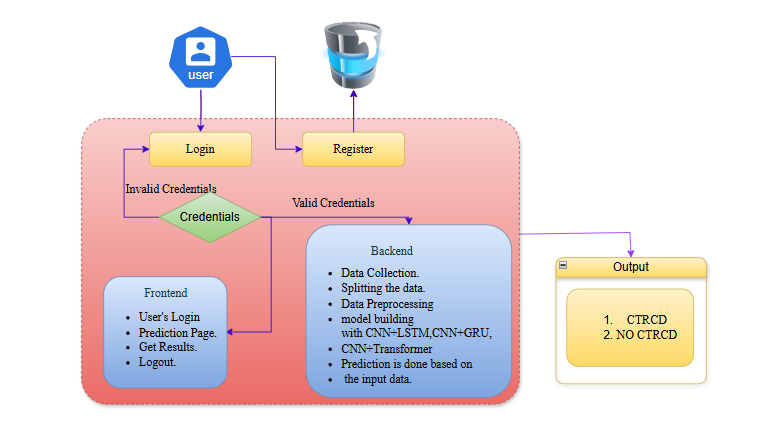
Block Diagram
Specifications
Hardware Requirements
Processor - I3/Intel Processor
Hard Disk - 160GB
Key Board - Standard Windows Keyboard
Mouse - Two or Three Button Mouse
Monitor - SVGA
RAM - 8GB
Software Requirements:
Operating System : Windows 7/8/10
Server side Script : HTML, CSS, Bootstrap & JS
Programming Language : Python
Libraries : Flask, Pandas, Mysql.connector, Os, Smtplib, Numpy
IDE/Workbench : PyCharm
Technology : Python 3.6+
Server Deployment : Xampp Server
Database : MySQL


 Paper Publishing

Request Call Back
Would you like to receive a free callback now?
Choose the best time for callback:
Leave your message and we will contact you as soon as possible

6-2-85/B, Old Maternity Hospital Road, Thyagaraja Nagar, Tirupati, Andhra Pradesh – 517501
+91 9030333433
+91 9393939065
0877-2261612

Disclaimer - Takeoff Edu Group Projects are not associated or affiliated with IEEE in any way. The IEEE Projects mentioned here are mentioned in the context of student projects, whose ideas are derived from IEEE publications, not projects of or by IEEE.

