A Multi-Task Attention-Driven Framework for Lung Infection Segmentation and Cancer Classification From HRCT Images
Objective
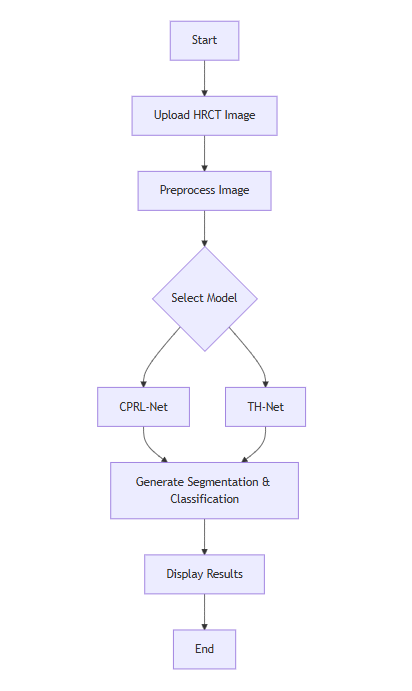
The objective of this project is to develop two independent attention-driven deep learning frameworks, CPRL Net and TH Net, for accurate lung disease analysis using HRCT images. CPRL Net focuses on improving early-stage lung cancer classification using boundary uncertainty maps derived from infection segmentation, while TH Net balances segmentation and classification tasks through bidirectional attention and dynamic task weighting. The project also aims to preprocess medical images for robust feature extraction, generate interpretable outputs such as segmentation masks and attention maps, and integrate the models into a Flask-based web application for automated diagnosis and clinical decision support.
Abstract
Lung infections and cancer are major causes of mortality worldwide, requiring accurate detection and diagnosis from high-resolution computed tomography (HRCT) images. This project develops two independent attention-driven deep learning frameworks: CPRL‑Net and TH‑Net. CPRL‑Net leverages boundary uncertainty maps from infection segmentation to enhance early-stage cancer classification, emulating radiologist workflows by focusing on lesion margins and edge characteristics. TH‑Net introduces bidirectional attention and task harmonization to independently optimize segmentation and classification tasks without relying on early transfer, using learnable scaling vectors and dynamic task weighting to balance losses automatically. Two datasets are employed: a lung cancer classification dataset and a COVID-19 lesion segmentation dataset. Preprocessing steps include resizing, normalization, and data augmentation to standardize input images and improve model performance. CPRL‑Net uses interleaved training batches and applies boundary priors during initial epochs to guide classification, while TH‑Net continuously harmonizes features across tasks using mutual attention and dynamic loss adjustment. Both models provide interpretable outputs, including segmentation masks, attention maps, and classification probabilities, enabling visual understanding of lesion location and severity. Experimental results indicate that CPRL‑Net excels in capturing boundary-sensitive features, improving classification accuracy, while TH‑Net efficiently balances segmentation and classification tasks for robust performance. This project demonstrates how task-specific attention mechanisms and boundary-aware feature learning can improve lung disease detection and support clinical decision-making.
Keywords: HRCT, lung cancer, COVID‑19, segmentation, classification, deep learning, attention mechanism, CPRL‑Net, TH‑Net, boundary uncertainty.
NOTE: Without the concern of our team, please don't submit to the college. This Abstract varies based on student requirements.
Block Diagram
Specifications
4.3 Hardware Requirements
Processor - I3/Intel Processor
Hard Disk - 160GB
Key Board - Standard Windows Keyboard
Mouse - Two or Three Button Mouse
Monitor - SVGA
RAM - 8GB
4.4 Software Requirements
Operating System : Windows 7/8/10
Programming Language : Python
Libraries : Pandas, Numpy, scikit-learn.
IDE/Workbench : Visual Studio Code.
Framework : Flask


 Paper Publishing

Request Call Back
Would you like to receive a free callback now?
Choose the best time for callback:
Leave your message and we will contact you as soon as possible

6-2-85/B, Old Maternity Hospital Road, Thyagaraja Nagar, Tirupati, Andhra Pradesh – 517501
+91 9030333433
+91 9393939065
0877-2261612

Disclaimer - Takeoff Edu Group Projects are not associated or affiliated with IEEE in any way. The IEEE Projects mentioned here are mentioned in the context of student projects, whose ideas are derived from IEEE publications, not projects of or by IEEE.

