A Multi-Scale Feature Fusion Method Based on DenseNet for UWB Radar Gesture Recognition
Objective
The objective of this project is to develop an efficient UWB radar-based hand gesture recognition system using deep learning. The project implements a baseline MSF DenseNet and proposes two enhanced models: DMSF DenseNet for adaptive multi-scale feature extraction and CSA DenseNet for cross-sensor attention-based fusion. The system aims to improve recognition accuracy while maintaining low computational complexity. The models are trained and evaluated on RTM images from three radar sensors. A Flask web application is also developed to allow users to upload gesture images and receive predicted gesture labels with confidence scores.
Abstract
This project presents a gesture recognition system using ultra‑wideband (UWB) radar sensors and deep learning. The dataset contains range‑time maps from three radar sensors placed at left, right, and top positions, covering twelve dynamic hand gestures. A baseline multi‑scale feature fusion DenseNet (MSF‑DenseNet) is implemented, which uses parallel convolutions of different kernel sizes to extract spatial features. Two novel models are proposed to improve recognition capability. The first, DMSF‑DenseNet, introduces dynamic weighting of the multi‑scale convolution branches based on input content. The second, CSA‑DenseNet, adds a cross‑sensor attention module that learns to reweight the three radar channels before feature extraction. The models are trained, validated, and tested using a fixed data split. A web application is developed using Flask, HTML, CSS, and JavaScript, providing modules for user registration, login, image upload, classification, and logout. The best performing model is deployed for inference, returning predicted gesture labels with confidence scores. The system demonstrates that attention‑based sensor fusion enhances radar‑based gesture recognition without adding computational overhead.
Keywords: UWB radar, gesture recognition, DenseNet, multi‑scale feature fusion, cross‑sensor attention, dynamic convolution, range‑time maps, deep learning, Flask web application, sensor fusion.
NOTE: Without the concern of our team, please don't submit to the college. This Abstract varies based on student requirements.
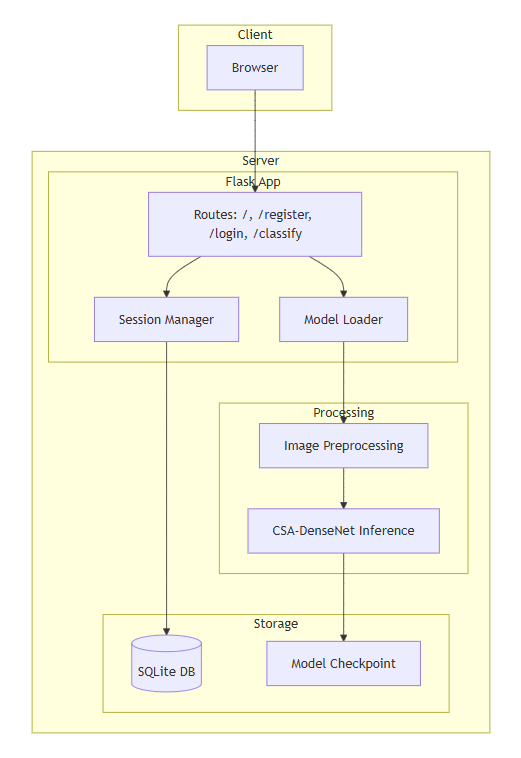
Block Diagram
Specifications
4.3 Hardware Requirements
Processor - I3/Intel Processor
Hard Disk - 160GB
Key Board - Standard Windows Keyboard
Mouse - Two or Three Button Mouse
Monitor - SVGA
RAM - 8GB
4.4 Software Requirements
Operating System : Windows 7/8/10
Programming Language : Python
Libraries : Pandas, Numpy, scikit-learn.
IDE/Workbench : Visual Studio Code.
Framework : Flask


 Paper Publishing

Request Call Back
Would you like to receive a free callback now?
Choose the best time for callback:
Leave your message and we will contact you as soon as possible

6-2-85/B, Old Maternity Hospital Road, Thyagaraja Nagar, Tirupati, Andhra Pradesh – 517501
+91 9030333433
+91 9393939065
0877-2261612

Disclaimer - Takeoff Edu Group Projects are not associated or affiliated with IEEE in any way. The IEEE Projects mentioned here are mentioned in the context of student projects, whose ideas are derived from IEEE publications, not projects of or by IEEE.

