A multi-faceted approach to electricity theft detection: Using community engagement, audit analytics, and machine learning algorithms
Objective
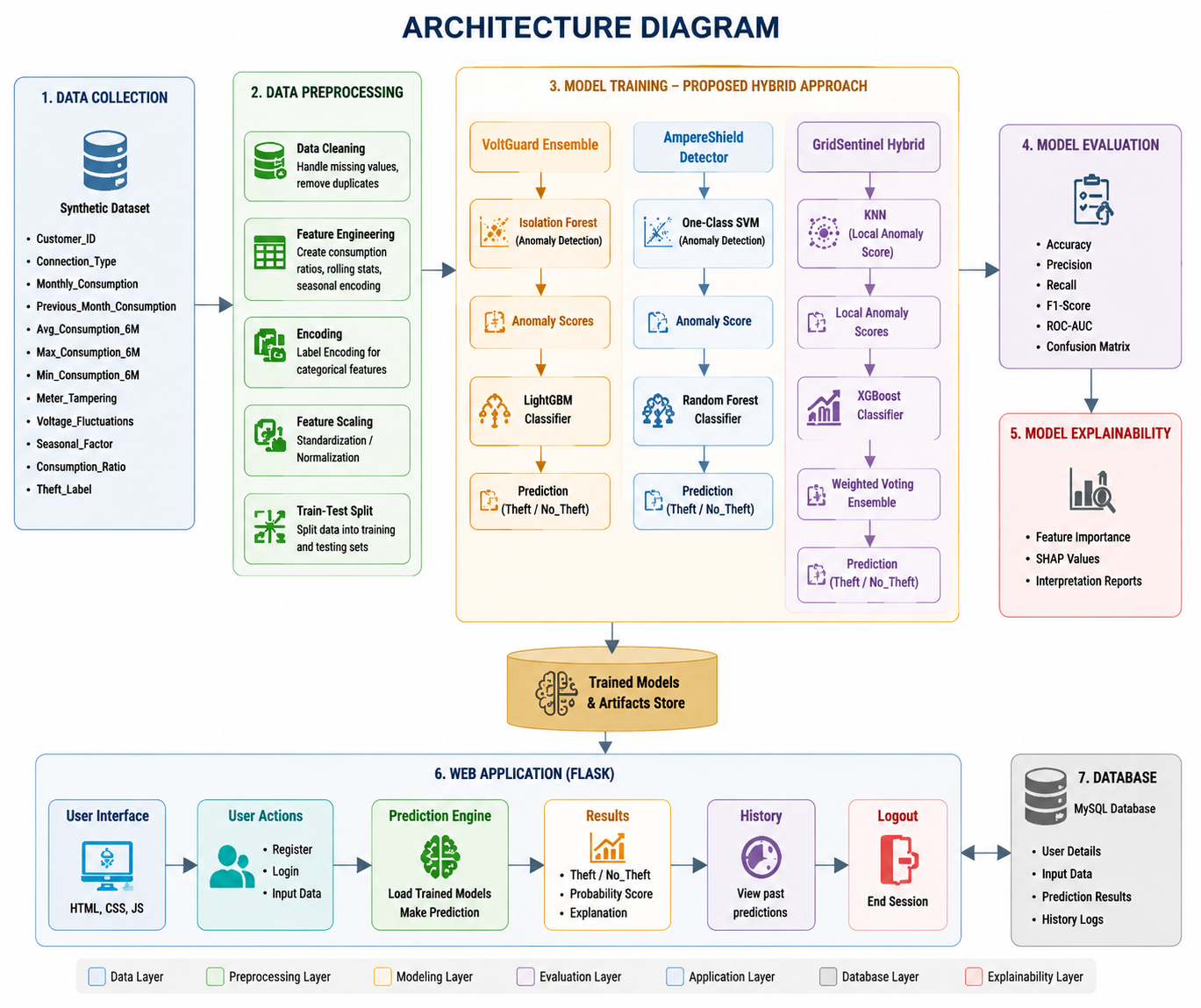
The objective of this project is to develop an intelligent system that can accurately detect electricity theft by analyzing consumption patterns and other relevant customer data. It combines traditional anomaly detection techniques with advanced machine learning algorithms to identify unusual behavior. The system aims to enhance efficiency in monitoring electricity usage, reduce losses due to theft, and provide utility companies with a reliable tool for proactive detection and decision-making.
Abstract
Abstract:
Electricity theft is a critical issue causing significant revenue losses for utility companies and disrupting energy distribution. Traditional detection methods often rely on manual inspections or simplistic analytics, which are inefficient and prone to errors. This project presents a multi-faceted approach for electricity theft detection, combining anomaly detection, hybrid machine learning algorithms, and audit analytics. A synthetic dataset representing customer consumption, meter tampering, and voltage fluctuations is utilized to simulate real-world scenarios. The project proposes three hybrid models: VoltGuard Ensemble, AmpereShield Detector, and GridSentinel Hybrid, which integrate Isolation Forest, One-Class SVM, KNN, LightGBM, Random Forest, and XGBoost techniques. These models are designed to capture subtle anomalies, local neighborhood patterns, and nonlinear feature interactions. Preprocessing steps include feature scaling, label encoding, and engineered anomaly scores. The system is implemented with a Python Flask backend, HTML/CSS/JS frontend, and MySQL database for storage. Model evaluation uses accuracy, precision, recall, F1-score, and confusion matrices. This hybrid approach improves detection performance compared to existing machine learning methods. The project emphasizes explainability, allowing insights into feature contributions for theft predictions. It provides a scalable, efficient, and automated framework to detect electricity theft in diverse consumption environments. The proposed methodology demonstrates high accuracy and robustness, minimizing false positives and enabling timely intervention. This system can assist utility providers in revenue protection, smart grid monitoring, and customer behaviour analysis. Future work can extend to real-time monitoring, integration with IoT smart meters, and adaptive learning with evolving consumption patterns.
Keywords
Electricity theft, anomaly detection, hybrid machine learning, Isolation Forest, One-Class SVM, KNN, LightGBM, Random Forest, XGBoost, consumption analysis
NOTE: Without the concern of our team, please don't submit to the college. This Abstract varies based on student requirements.
Block Diagram
Specifications
4.1 SOFTWARE REQUIREMENS
Operating System : Windows 7/8/10
Server side Script : html,css,js
Programming Language : Python
Libraries : Django, Pandas, Torch, Keras, Sklearn, Numpy , Seaborn
IDE/Workbench : VSCode
Server Deployment : Xampp Server
Database : SQLite
4.2 HARDWARE REQUIREMENTS
Processor - I3/Intel Processor
RAM - 8GB (min)
Hard Disk - 128 GB
Key Board - Standard Windows Keyboard
Mouse - Two or Three Button Mouse
Monitor - Any

Demo Video


Request for Video
 Paper Publishing
Request Call Back
Would you like to receive a free callback now?
Choose the best time for callback:
Leave your message and we will contact you as soon as possible

6-2-85/B, Old Maternity Hospital Road, Thyagaraja Nagar, Tirupati, Andhra Pradesh – 517501
+91 9030333433
+91 9393939065
0877-2261612

Disclaimer - Takeoff Edu Group Projects are not associated or affiliated with IEEE in any way. The IEEE Projects mentioned here are mentioned in the context of student projects, whose ideas are derived from IEEE publications, not projects of or by IEEE.

