A Machine Learning Based Real Time Remaining Useful Life Estimation and Fair Pricing Strategy for Electric Vehicle Battery Swapping Stations
Objective
The objective of this project is to develop a machine learning-based framework that accurately predicts the Remaining Useful Life (RUL) of electric vehicle (EV) batteries using multiple regression models, including XGBoost, Random Forest, KNN, Stacking, and Voting Regressor. The system aims to improve battery lifecycle management through real-time estimation, enabling predictive maintenance and optimizing fair pricing at battery swapping stations.
Abstract
This project introduces a machine learning-based framework for accurately estimating the Remaining Useful Life (RUL) of electric vehicle (EV) batteries and implementing a fair pricing model in battery swapping stations. The existing system leverages XGBoost Regression to predict RUL based on operational parameters. To enhance prediction performance and system robustness, the proposed approach integrates multiple regression models including Random Forest Regressor, K-Nearest Neighbors (KNN), Stacking Regressor, and Voting Regressor. These models are trained on real-world battery features such as discharge time, cycle index, voltage thresholds, and charge duration. Ensemble methods such as stacking and voting are employed to combine the strengths of individual models, improving overall accuracy. The predicted RUL is used to dynamically calculate fair pricing, ensuring cost-effectiveness and reliability for EV users. This system supports predictive maintenance and promotes the sustainability of EV infrastructure by enabling data-driven battery lifecycle management in real time.
Keywords: Remaining Useful Life (RUL), Electric Vehicles (EV), Battery Swapping Stations, XGBoost, Random Forest, KNN, Stacking, Voting Regressor, Fair Pricing, Predictive Maintenance, Real-Time Estimation, Ensemble Learning.
NOTE: Without the concern of our team, please don't submit to the college. This Abstract varies based on student requirements.
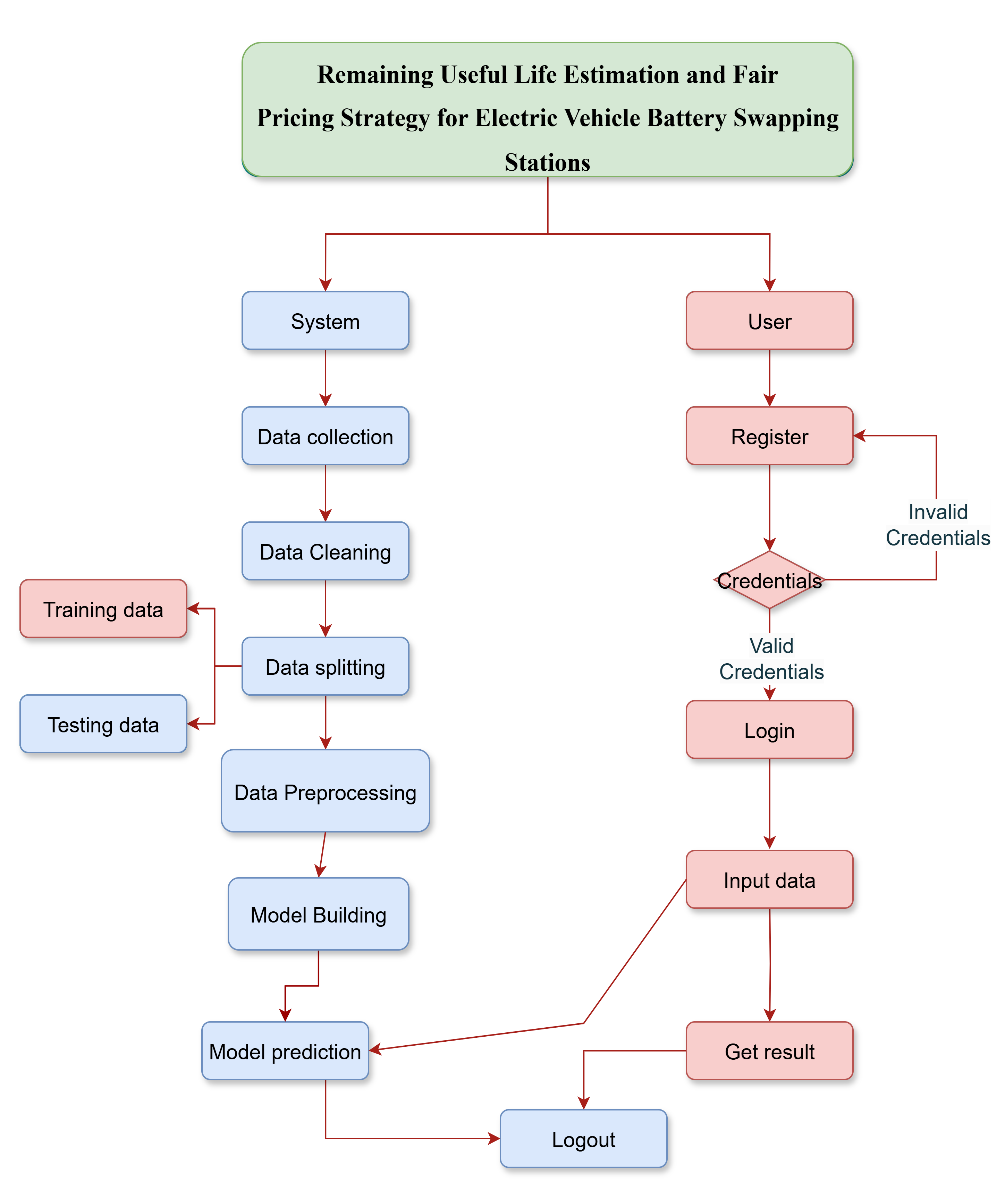
Block Diagram
Specifications
Hardware Requirements
Processor - I3/Intel Processor
Hard Disk - 160GB
Key Board - Standard Windows Keyboard
Mouse - Two or Three Button Mouse
Monitor - SVGA
RAM - 8GB
Software Requirements:
Operating System : Windows 7/8/10
Server side Script : HTML, CSS, Bootstrap & JS
Programming Language : Python
Libraries : Flask/Django, Pandas, Mysql.connector, Os, Smtplib, Numpy
IDE/Workbench : PyCharm
Technology : Python 3.6+
Server Deployment : Xampp Server
Database : MySQL

Demo Video


Request for Video
 Paper Publishing
Request Call Back
Would you like to receive a free callback now?
Choose the best time for callback:
Leave your message and we will contact you as soon as possible

6-2-85/B, Old Maternity Hospital Road, Thyagaraja Nagar, Tirupati, Andhra Pradesh – 517501
+91 9030333433
+91 9393939065
0877-2261612

Disclaimer - Takeoff Edu Group Projects are not associated or affiliated with IEEE in any way. The IEEE Projects mentioned here are mentioned in the context of student projects, whose ideas are derived from IEEE publications, not projects of or by IEEE.

