A Machine Learning Based Cyber Attack Detection Model for Wireless Sensor Networks in Microgrid
Objective
The objective of this project is to develop an intrusion detection system for wireless sensor networks using machine learning algorithms such as Random Forest, Decision Tree, K-Nearest Neighbors (KNN), XGBoost, and CatBoost. The system aims to accurately classify network traffic as normal or malicious while maintaining efficiency in resource-constrained environments and improving security through reliable and interpretable predictions
Abstract
The Wireless Sensor Networks (WSNs) are undergoing rapid implementation in various fields like environmental monitoring, health care, and military surveillance. But the open and distributed nature of WSNs exposes them seriously to attacks like unauthorized access of the data, node capturing, and data injection attacks. In this research, I am presenting the enhancement of a further Advanced Intrusion Detection System for Wireless Sensor Networks with the application of machine learning techniques to strengthen the security. The framework employs the XGBoost and CatBoost classifiers for effective attack detection based on diverse features of the network. Furthermore, Explainable AI (XAI) techniques have been integrated into the system to ensure transparency with maximum interpretability, allowing the network administrator to easily comprehend the security decision-making made by the system. The proposed models are evaluated using the WSN-DS dataset from Kaggle, which has many instances labeled for different possible attack scenarios. Compared with conventional Intrusion Detection Systems, our approach showed improvements in performance measures like accuracy, precision, and recall, providing a strong framework to secure WSNs against several attacks. Also, this integration of XAI will provide trust and usability among other stakeholders, thus allowing informed decision-making concerning network defense mechanisms.
NOTE: Without the concern of our team, please don't submit to the college. This Abstract varies based on student requirements.
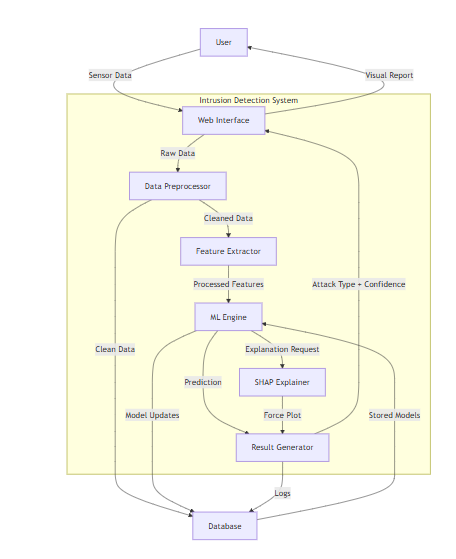
Block Diagram
Specifications
Software Requirements
Software’s : Python 3.10 or high version
IDE : Visual Studio Code.
Framework : Flask
IDE/Workbench : Jupyter Notebook
Technology : Python 3.10+
Libraries : numpy, pandas, scikit-learn, xgboost, catboost
Database : MySQL
Hardware Requirements
Operating system : Windows 7 or 7+
RAM : 8 GB
Hard disc or SSD : More than 500 GB
Processor : Intel 3rd generation or high or Ryzen with 8 GB Ram


 Paper Publishing

Request Call Back
Would you like to receive a free callback now?
Choose the best time for callback:
Leave your message and we will contact you as soon as possible

6-2-85/B, Old Maternity Hospital Road, Thyagaraja Nagar, Tirupati, Andhra Pradesh – 517501
+91 9030333433
+91 9393939065
0877-2261612

Disclaimer - Takeoff Edu Group Projects are not associated or affiliated with IEEE in any way. The IEEE Projects mentioned here are mentioned in the context of student projects, whose ideas are derived from IEEE publications, not projects of or by IEEE.

