A Machine Learning Approach to Explore and Predict Student Motivation Types
Objective
This study aims to develop an integrated framework for predicting student motivation using machine learning techniques. It employs multi-source data from a UK-based Computer Science department and evaluates Random Forest, Stacking Classifier, and Voting Classifier. The Random Forest model achieves the highest accuracy of 0.9950, while the Stacking Classifier and Voting Classifier models perform well with accuracies of 0.9900 and 98.00%, respectively. The research explores using Kaggle data to classify student motivation and supports the effectiveness of these models. While promising, the study's applicability across broader educational contexts requires further validation.
Abstract
Motivation plays a significant role in shaping students’ educational outcomes. Understanding the factors that influence student motivation is crucial for enhancing academic performance and designing effective learning environments. This study utilizes to examine various types of motivation, aiming to develop an integrated framework for analyzing and predicting student motivation. The proposed framework employs multi-source data and evaluates three machine learning techniques: Random Forest, Stacking Classifier, and Voting Classifier. These models are applied to data collected from a UK-based institution, specifically from the Computer Science department. The findings highlight the superior performance of the Random Forest model in identifying learning analytics characteristics that influence each motivation type, achieving an accuracy of 0.9950. The Stacking Classifier model also demonstrates strong performance, with an accuracy of 0.9900, while the Voting Classifier model achieves an accuracy of 98.00%. Additionally, this study explores the underlying philosophy of using Kaggle data and its features to classify student motivation, supporting the effectiveness of these machine learning techniques in this context. While the results are promising within the context of a single-institution Computer Science setting, further studies are needed to validate the applicability of this methodology across broader educational frameworks.
Keywords:motivation, machine learning, learning analytics, prediction, Random Forest Classifier, Stacking classifier, voting classifier, explainable AI in education.
NOTE: Without the concern of our team, please don't submit to the college. This Abstract varies based on student requirements.
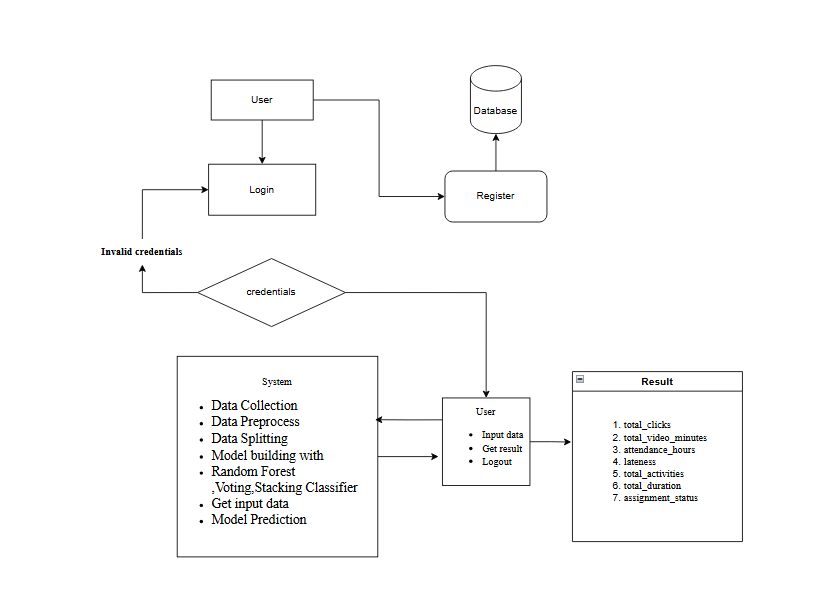
Block Diagram
Specifications
Hardware Requirements
Processor - I3/Intel Processor
Hard Disk - 160GB
Key Board - Standard Windows Keyboard
Mouse - Two or Three Button Mouse
Monitor - SVGA
RAM - 8GB
Software Requirements:
Operating System : Windows 7/8/10
Server side Script : HTML, CSS, Bootstrap & JS
Programming Language : Python
Libraries : Flask, Pandas, Json, MYSQL, NumPy, TensorFlow,
Sklearn, seaborn
IDE/Workbench : VS Code
Technology : Python 3.10
Database : SQLite


 Paper Publishing

Request Call Back
Would you like to receive a free callback now?
Choose the best time for callback:
Leave your message and we will contact you as soon as possible

6-2-85/B, Old Maternity Hospital Road, Thyagaraja Nagar, Tirupati, Andhra Pradesh – 517501
+91 9030333433
+91 9393939065
0877-2261612

Disclaimer - Takeoff Edu Group Projects are not associated or affiliated with IEEE in any way. The IEEE Projects mentioned here are mentioned in the context of student projects, whose ideas are derived from IEEE publications, not projects of or by IEEE.

