A Machine Learning Approach for Collusion Detection in Electricity Markets Based on Nash Equilibrium Theory
Objective
The main objective of the project is to provide a tool for independent system operators to detect the collusion and identify the colluding firms by using day-ahead data.
Abstract
We aim to provide a tool for independent system operators to detect the collusion and identify the colluding firms by using day-ahead data. In this paper, an approach based on supervised machine learning is presented for collusion detection in electricity markets. The possible scenarios of the collusion among generation firms are firstly identified. Then, for each scenario and possible load demand, market equilibrium is computed. Market equilibrium points under different collusion and their peripheral points are used to train the collusion detection machine using supervised learning approaches such as classification and regression tree (CART) and support vector machine (SVM) algorithms. By applying the proposed approach to a four-firm and ten-generator test system, the accuracy of the proposed approach is evaluated and the efficiency of SVM and CART algorithms in collusion detection are com‐ pared with other supervised learning and statistical techniques.
Keywords: support vector machine (SVM), classification and regression tree (CART)
NOTE: Without the concern of our team, please don't submit to the college. This Abstract varies based on student requirements.
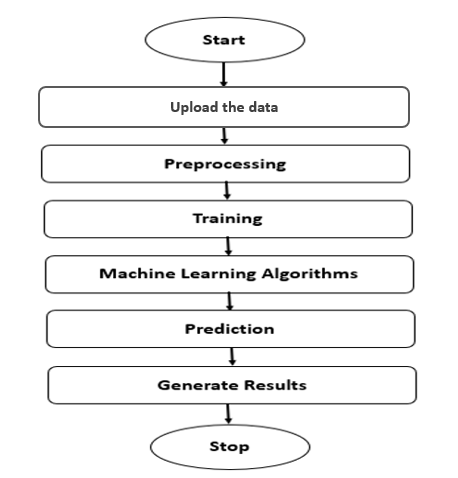
Block Diagram
Specifications
Hardware:
Operating system : Windows 7 or 7+
RAM : 8 GB
Hard disc or SSD : More than 500 GB
Processor : Intel 3rd generation or high or Ryzen with 8 GB Ram
Software:
Software’s : Python 3.6 or high version
IDE : PyCharm
Framework : Flask


 Paper Publishing

Request Call Back
Would you like to receive a free callback now?
Choose the best time for callback:
Leave your message and we will contact you as soon as possible

6-2-85/B, Old Maternity Hospital Road, Thyagaraja Nagar, Tirupati, Andhra Pradesh – 517501
+91 9030333433
+91 9393939065
0877-2261612

Disclaimer - Takeoff Edu Group Projects are not associated or affiliated with IEEE in any way. The IEEE Projects mentioned here are mentioned in the context of student projects, whose ideas are derived from IEEE publications, not projects of or by IEEE.

