A Lyapunov Function Based Model Predictive Control For Three Phase Grid Connected Photovoltaic Converters
Also Available Domains Solar Power Generation|
Abstract
A Lyapunov function based model predictive control for three phase grid connected photovoltaic converters
Abstract:
In this paper, a predictive direct power control (PDPC) method based on Lyapunov function approach is developed for control of grid connected photovoltaic (PV) converter. The predictive control algorithm utilizes the discrete model of the PV converter and predicts the future active and reactive power of the system by calculating a cost function for all voltage vectors. Subsequently, the optimal voltage vector that minimizes the cost function is selected to calculate the model variables in the next sampling instant. The proposed controller predicts error before the switching signal is applied to the high-gain multilevel PV converter and thus is able to choose the next switch event to minimize error between the commanded and actual converter operation. This technique improves the speed at which the controller can track rapid changes in solar insolation and results in an increase in the overall system output power. In the proposed technique, there is no need to adjust the control parameters under changing loads or model parameters uncertainties. Also, the use of many classical controllers is eliminated and only one PI controller is used for DC link voltage. Moreover, contrary to the conventional PDPC, the optimal switching vector is determined only based on active and reactive power and hence, the computation burden is significantly reduced and the convergence is speed up. The detail modeling and design of the proposed controller are verified through computer simulations under different operating conditions. Also, the robustness of the control approach is illustrated in the presence of parameters uncertainties and change in solar irradiations. Simulation results show that the proposed control strategy maintains the active and reactive powers as close as possible to the desired values under different operation mode.
NOTE: Without the concern of our team, please don't submit to the college. This Abstract varies based on student requirements.
Block Diagram
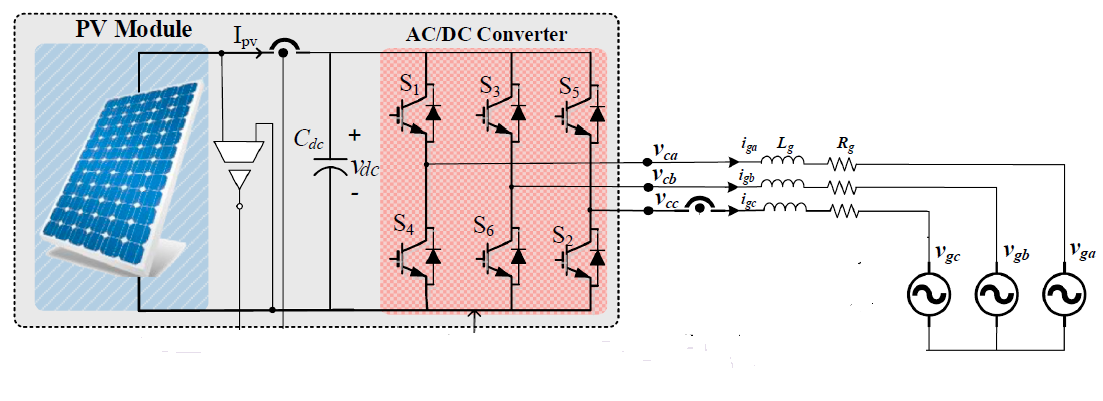
Specifications
Software Configuration:
Operating System : Windows 7/8/10
Application Software : Matlab/Simulink
Hardware Configuration:
RAM : 8 GB / 4 GB (Min)
Processor : I3 / I5(Mostly prefer)
Learning Outcomes
- Introduction to Matlab/Simulink
- What is EISPACK & LINPACK
- How to start with MATLAB
- About Matlab language
- About tools & libraries
- Application of Matlab/Simulink
- About Matlab desktop
- Features of Matlab/Simulink
- Basics on Matlab/Simulink
- Introduction to controllers.
- Study of PWM techniques.
- Project Development Skills:
- Problem analyzing skills
- Problem solving skills
- Creativity and imaginary skills
- Programming skills
- Deployment
- Testing skills
- Debugging skills
- Project presentation skills
- Thesis writing skills
Demo Video


Request for Video
 Paper Publishing
Request Call Back
Would you like to receive a free callback now?
Choose the best time for callback:
Leave your message and we will contact you as soon as possible

6-2-85/B, Old Maternity Hospital Road, Thyagaraja Nagar, Tirupati, Andhra Pradesh – 517501
+91 9030333433
+91 9393939065
0877-2261612

Disclaimer - Takeoff Edu Group Projects are not associated or affiliated with IEEE in any way. The IEEE Projects mentioned here are mentioned in the context of student projects, whose ideas are derived from IEEE publications, not projects of or by IEEE.

