A LOW-POWER AND RECONFIGURABLE 16-BIT ADDER USING REVERSIBLE GATES
Objective
The main objective of this project is to design and implement a low-power, energy-efficient, and reconfigurable 16-bit adder using reversible logic gates. The proposed design aims to minimize power dissipation and heat generation by reducing information loss, which is a fundamental advantage of reversible computing
Abstract
Key Words: Field Programmable Gate Array (FPGA), Error Tolerant Adder (ETA), Toffoli gate, Reversible gates,Power Optimization, Reconfigurable , Low Power Adder(LPA).
NOTE: Without the concern of our team, please don't submit to the college. This Abstract varies based on student requirements.
Block Diagram
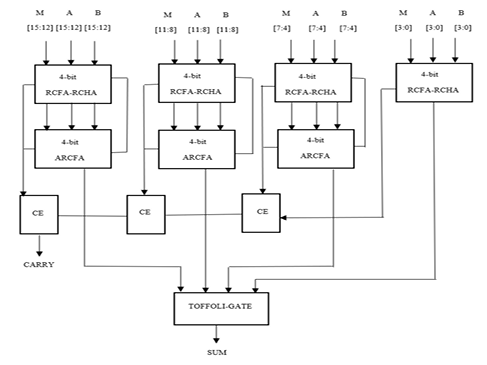
Specifications
· Xilinx Vivado Tool
· HDL: Verilog
Learning Outcomes
Understand the fundamentals of reversible logic and its importance in low-power digital design.
Gain knowledge about reversible gates such as Feynman, Toffoli, Fredkin, and Peres gates.
Learn how to design and implement a 16-bit adder using reversible logic principles.
Analyze and minimize key parameters such as quantum cost, garbage outputs, constant inputs, and propagation delay.
Develop skills in hardware description languages like Verilog/VHDL for circuit modeling and simulation.
Perform functional verification and performance comparison between reversible and conventional adders.


Related Projects
 Paper Publishing

Request Call Back
Would you like to receive a free callback now?
Choose the best time for callback:
Leave your message and we will contact you as soon as possible

6-2-85/B, Old Maternity Hospital Road, Thyagaraja Nagar, Tirupati, Andhra Pradesh – 517501
+91 9030333433
+91 9393939065
0877-2261612

Disclaimer - Takeoff Edu Group Projects are not associated or affiliated with IEEE in any way. The IEEE Projects mentioned here are mentioned in the context of student projects, whose ideas are derived from IEEE publications, not projects of or by IEEE.

