A Lightweight Factory Unsafe Behavior Recognition Method With Occlusion-Robust Adaptive Fusion
Objective
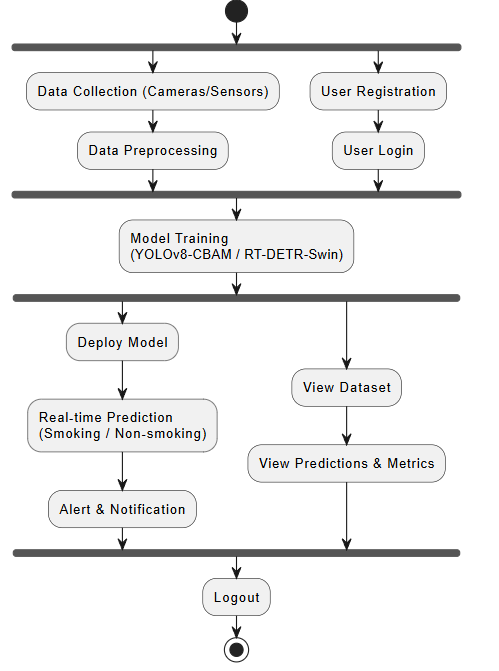
The objective of this project is to develop a real-time factory unsafe behavior recognition system based on deep learning techniques, specifically YOLOv8-CBAM and RT-DETR-Swin. The project aims to enhance safety monitoring by detecting factory smoking behavior using images captured through surveillance systems. By leveraging the capabilities of YOLOv8-CBAM for object detection, RT-DETR-Swin for improved multi-object tracking, and Adaptive Fusion for enhanced localization, the system aims to automatically identify smoking behavior as they occur. The integration of CBAM will provide visual interpretability by highlighting regions in the image that influence the model's decisions. The goal is to create an efficient, automated solution for factory unsafe behavior recognition, enabling rapid response to unsafe behaviors and enhancing safety management systems.
Abstract
This paper
presents a novel approach to real-time factory unsafe behavior recognition
using YOLOv8-CBAM, RT-DETR-Swin, CBAM, and Adaptive Fusion. The system aims to
identify unsafe behaviors, specifically smoking behavior, by processing image
datasets through advanced object detection techniques. The YOLOv8-CBAM and
RT-DETR-Swin models are employed for detecting objects in images, with Adaptive
Fusion applied to enhance the accuracy of object localization by reducing
redundant predictions. CBAM is utilized for visual interpretability, providing
insights into the decision-making process of the models by generating class
activation maps. The detection process focuses on a single class: smoking, and
optimizes the performance by fine-tuning hyperparameters and leveraging the
strengths of these advanced models. The methodology improves the robustness and
precision of unsafe behavior recognition in real-time applications, offering a
scalable solution for automated factory safety and compliance systems.
Keywords: YOLOv8-CBAM, RT-DETR-Swin, CBAM, Adaptive Fusion, factory unsafe behavior recognition, smoking behavior detection, object detection, hyperparameter optimization, machine learning, deep learning.
NOTE: Without the concern of our team, please don't submit to the college. This Abstract varies based on student requirements.
Block Diagram
Specifications
4.2 SOFTWARE REQUIREMENS
Operating System : Windows 7/8/10
Server side Script : html,css,js
Programming Language : Python
Libraries : Flask, Pandas, pytorch Numpy , Seaborn
IDE/Workbench : VSCode
Database : SQLite
4.3 HARDWARE REQUIREMENTS
Processor - I3/Intel Processor
RAM - 8GB (min)
Hard Disk - 128 GB
Key Board - Standard Windows Keyboard
Mouse - Two or Three Button Mouse
Monitor - Any

Demo Video


Request for Video
 Paper Publishing
Request Call Back
Would you like to receive a free callback now?
Choose the best time for callback:
Leave your message and we will contact you as soon as possible

6-2-85/B, Old Maternity Hospital Road, Thyagaraja Nagar, Tirupati, Andhra Pradesh – 517501
+91 9030333433
+91 9393939065
0877-2261612

Disclaimer - Takeoff Edu Group Projects are not associated or affiliated with IEEE in any way. The IEEE Projects mentioned here are mentioned in the context of student projects, whose ideas are derived from IEEE publications, not projects of or by IEEE.

