A Hybrid PSO-GA Optimized Approach for COVID-19 Detection Using CT Scan
Objective
This project aims to develop an AI-powered system for the automated detection of COVID-19 from CT scan images. The system will include two deep learning models: MobileNetV2, a lightweight model for fast inference, and a custom CNN-Transformer hybrid architecture (EfficientNetV2B0 + MultiHeadAttention + MixUp) to capture global lung patterns. The models will be fine-tuned using a hybrid optimization approach that combines Particle Swarm Optimization (PSO) and Genetic Algorithm (GA) to improve accuracy and reduce overfitting. Performance will be compared across MobileNetV2, DenseNet121, ResNet50, and the proposed hybrid model using metrics like accuracy, AUC-ROC, precision, recall, and F1-score. A Flask-based web platform will be developed for real-time predictions, allowing users to upload CT scan images. The system will also be scalable and deployable, with secure user authentication and data management via MySQL, designed to handle high volumes of CT scans for healthcare applications.
Abstract
Abstract
The ongoing challenges in global health security necessitate the development of rapid, non-invasive, and highly accurate diagnostic tools for respiratory infections such as COVID-19. This study presents a dual-architecture deep learning framework for the automated detection of COVID-19 from CT scan images, leveraging both a lightweight MobileNetV2 model and a novel CNN-Transformer hybrid. To optimize performance, a hybrid optimization approach combining Particle Swarm Optimization (PSO) and Genetic Algorithm (GA) is employed to fine-tune hyperparameters, addressing the limitations of manual tuning and enhancing model generalization. The proposed methodology evaluates two distinct pipelines: (1) A transfer learning-based MobileNetV2 architecture fine-tuned with PSO-GA, and (2) A custom hybrid model utilizing an EfficientNetV2B0 backbone fused with a MultiHeadAttention mechanism and MixUp augmentation to capture global lung parenchyma patterns. Extensive experiments were conducted on a balanced dataset of 3,541 CT images, with an 80/20 stratified split. Experimental results demonstrate the efficacy of the hybrid optimization strategy. The CNN-Transformer hybrid model achieved a state-of-the-art validation accuracy of 94.6% and an AUC of 0.992, significantly outperforming traditional CNNs. The optimized MobileNetV2 model also achieved robust performance with 92.3% accuracy and high computational efficiency. The integration of PSO-GA proved critical in reducing overfitting and optimizing the learning rate, dense layer units, and dropout rates. These findings suggest that the proposed hybrid attention-based model offers a superior trade-off between sensitivity and specificity, providing a reliable decision-support system for clinicians in high-volume screening environments.
Keywords: COVID-19 Detection, CT Scan Analysis, MobileNetV2, CNN-Transformer, MultiHeadAttention, Hybrid PSO-GA Optimization, Deep Learning, EfficientNetV2, MixUp Augmentation, Medical Image Classification, Pneumonia Detection.
NOTE: Without the concern of our team, please don't submit to the college. This Abstract varies based on student requirements.
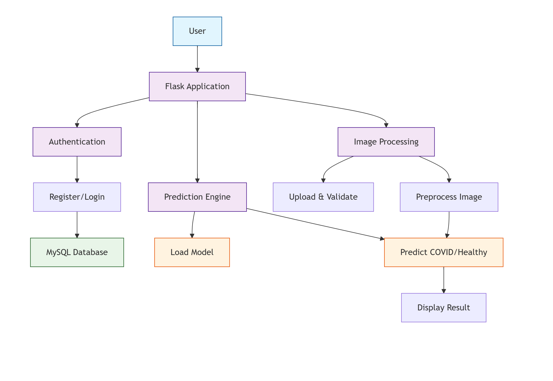
Block Diagram
Specifications
4.1 SOFTWARE REQUIREMENS
Operating System : Windows 7/8/10
Server side Script : HTML, CSS, Bootstrap & JS
Programming Language : Python
Libraries : Flask, Pandas, Torch, Keras, Sklearn, Numpy , Seaborn
IDE/Workbench : VSCODE
Server Deployment : Xampp Server
Database : MySQL
4.2 HARDWARE REQUIREMENTS
Processor - I3/Intel Processor
RAM - 8GB (min)
Hard Disk - 128 GB
Key Board - Standard Windows Keyboard
Mouse - Two or Three Button Mouse
Monitor - Any


 Paper Publishing

Request Call Back
Would you like to receive a free callback now?
Choose the best time for callback:
Leave your message and we will contact you as soon as possible

6-2-85/B, Old Maternity Hospital Road, Thyagaraja Nagar, Tirupati, Andhra Pradesh – 517501
+91 9030333433
+91 9393939065
0877-2261612

Disclaimer - Takeoff Edu Group Projects are not associated or affiliated with IEEE in any way. The IEEE Projects mentioned here are mentioned in the context of student projects, whose ideas are derived from IEEE publications, not projects of or by IEEE.

