A Hybrid Multi-Scale CNN–Transformer Framework with Cross-Attention Fusion for Alzheimer’s Disease Diagnosis
Objective
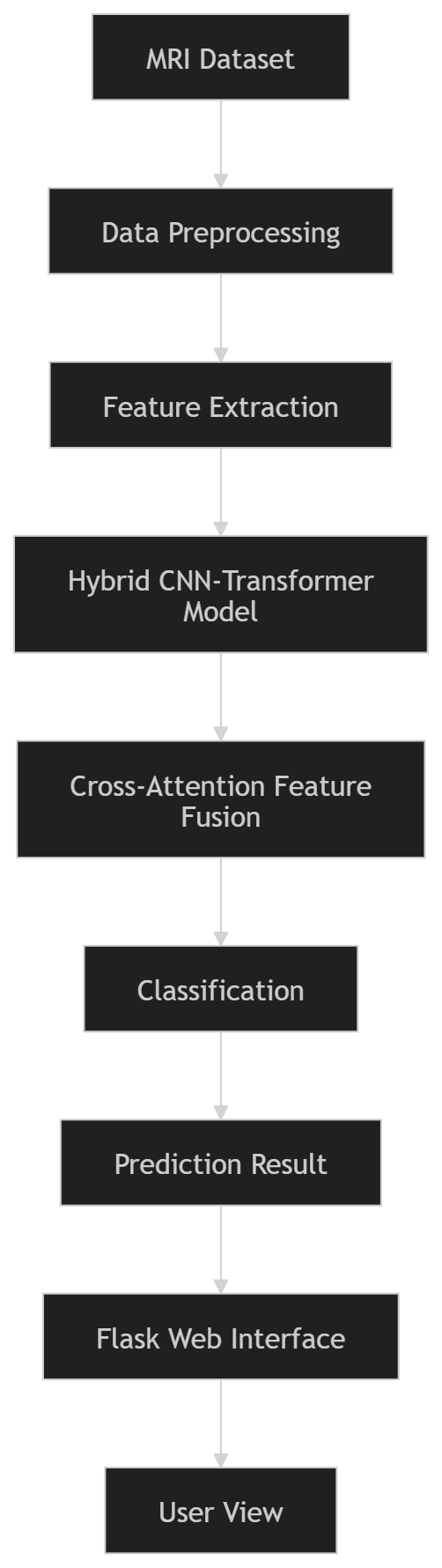
A Hybrid Multi-Scale CNN–Transformer Framework with Cross-Attention Fusion for Alzheimer’s Disease Diagnosis project presents a hybrid deep learning framework for the automated classification of Alzheimer’s disease using MRI brain images. The proposed system combines convolutional neural networks and transformer architectures to effectively capture both local structural details and global contextual information from medical images. Two advanced classification models are developed and evaluated: DCT-MRI Net, which utilizes dual CNN and Transformer encoders with a Cross-Attention Fusion mechanism to integrate complementary features, and MSF-S2T Net, which employs a multi-scale convolutional backbone followed by a Transformer encoder with Cross-Scale Attention to enhance feature representation across different image resolutions. Comprehensive preprocessing techniques are applied to improve data quality and consistency before model training. A classification head predicts the disease category based on the extracted features. The system is implemented through a Flask-based web application that enables users to upload MRI images and obtain classification results. By combining multi-scale learning, attention mechanisms, and feature fusion strategies, the framework aims to improve diagnostic accuracy, robustness, and efficiency for Alzheimer’s disease classification.
Abstract
This project
presents a hybrid deep learning framework for classification of Alzheimer’s
disease using MRI images. The approach combines convolution-based feature
extraction and transformer-based representation learning to capture both local
and global patterns. Two models are designed: DCT-MRI Net and MSF-S2T Net. The
first model uses dual encoders with a cross-attention fusion mechanism to
integrate features from convolutional and transformer branches. The second
model applies a multi-scale convolution backbone followed by a transformer
encoder with cross-scale attention. Both models focus on improving feature
interaction and representation quality. The dataset consists of MRI images
categorized into multiple classes, and preprocessing is applied to ensure
consistency. Feature fusion and attention mechanisms enhance the discriminative
capability of the network. A classification head is used to predict the output
class. The system is deployed using a web-based interface built with Flask,
allowing user interaction for image classification. The proposed framework aims
to achieve higher accuracy and efficiency compared to baseline models by
combining multi-scale and attention-based learning.
Keywords: Alzheimer classification, MRI imaging, CNN, Transformer, Cross-Attention, Multi-scale features, Feature fusion, Vision Transformer, Deep learning, Image classification
NOTE: Without the concern of our team, please don't submit to the college. This Abstract varies based on student requirements.
Block Diagram
Specifications
5.2 Hardware Requirements
Processor - I3/Intel Processor
Hard Disk - 160GB
Key Board - Standard Windows Keyboard
Mouse - Two or Three Button Mouse
Monitor - SVGA
RAM - 8GB
5.3 Software Requirements
• Operating System : Windows 7/8/10
• Programming Language : Python
• Libraries : Pandas, Numpy, scikit-learn, pytorch
• IDE/Workbench : Visual Studio Code.

Demo Video


Request for Video
 Paper Publishing
Request Call Back
Would you like to receive a free callback now?
Choose the best time for callback:
Leave your message and we will contact you as soon as possible

6-2-85/B, Old Maternity Hospital Road, Thyagaraja Nagar, Tirupati, Andhra Pradesh – 517501
+91 9030333433
+91 9393939065
0877-2261612

Disclaimer - Takeoff Edu Group Projects are not associated or affiliated with IEEE in any way. The IEEE Projects mentioned here are mentioned in the context of student projects, whose ideas are derived from IEEE publications, not projects of or by IEEE.

